The Son of Man Painting: Meaning, Value & the Story Behind Magritte’s Masterpiece
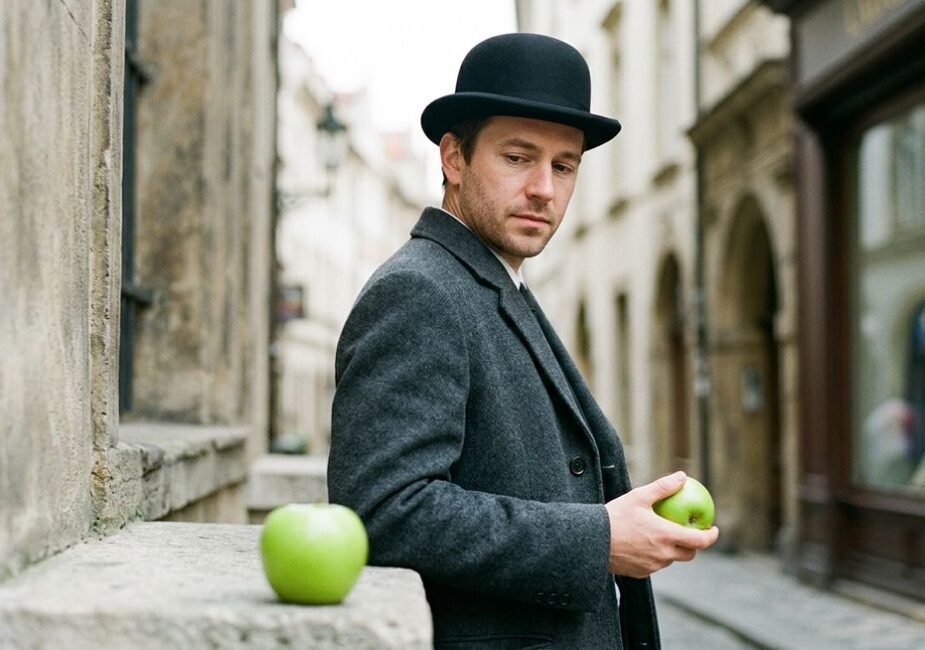
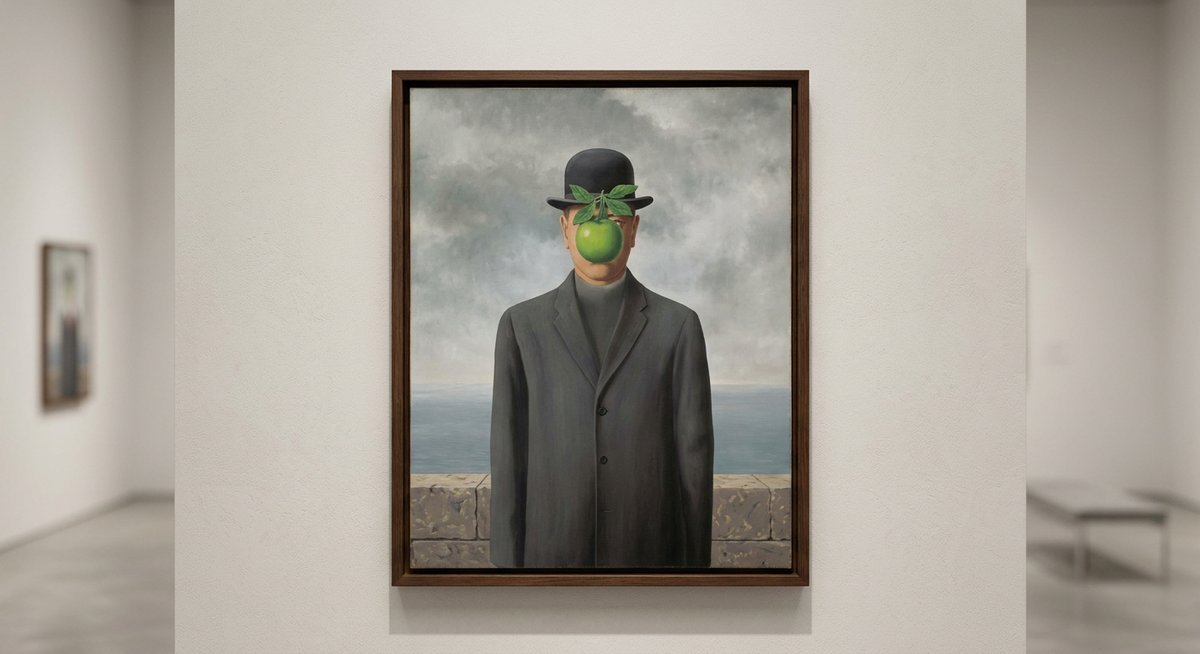
Rene Magritte painted The Son of Man in 1964 as a commissioned self-portrait, then covered his own face with a hovering green apple. The result became one of the most reproduced images in Western art: a bowler-hatted figure in a dark overcoat, standing before a low stone wall and an overcast coastal sky, his identity sealed behind a piece of fruit that has no business being there. The canvas measures 116 cm by 89 cm. The questions it provokes are considerably larger.
Magritte described the apple not as concealment but as confrontation. In a 1965 radio interview with Jean Neyens, he explained: “Everything we see hides another thing, we always want to see what is hidden by what we see.” The bowler hat, the suspended apple, the anonymous dark suit — none of it is accidental, and none of it resolves neatly. Sixty years after its creation, the son of man painting endures across art history syllabi, Hollywood heist films, Halloween costumes, and philosophical debates about the nature of identity. The image refuses to settle. That refusal is the point.
Who Painted the Son of Man — and Why?
Rene Magritte created The Son of Man in 1964, commissioned by his close friend and New York-based attorney Harry Torczyner, who requested a self-portrait. Magritte responded by painting his own likeness in oil on canvas — then concealing the face entirely behind a floating green apple, producing one of the twentieth century’s most recognizable images from the simplest possible ingredients.
Magritte’s Background and Artistic Vision
Born in Lessines, Belgium, in 1898, Magritte spent most of his working life in Brussels — deliberately distant from the Parisian center of the Surrealist movement. Where Salvador Dali melted clocks into fever-dream landscapes, Magritte painted impossible things with the flat, deadpan precision of a commercial illustrator. He had worked in advertising and wallpaper design early in his career, and that technical clarity never left his canvases.
His recurring motifs — bowler hats, pipes, dark suits, green apples, birds, curtains — were familiar objects stripped of their familiarity and placed where they did not belong. Magritte participated in the international Surrealist movement and corresponded with Andre Breton, but he resisted psychoanalytic readings of his work with notable stubbornness. According to art historian David Sylvester, whose interviews were published in Magritte: The Silence of the World (1992), Magritte insisted his paintings posed questions rather than encoded answers.
The Commission by Harry Torczyner
Torczyner’s brief was straightforward: paint yourself. Magritte did exactly that — and then concealed the result. The figure stands before a low stone wall with the grey-green Atlantic behind him, dressed in the same dark overcoat and bowler hat Magritte wore in photographs throughout his life. According to the Magritte Foundation catalogue records, the finished work was completed the same year it was commissioned, just three years before the artist’s death in 1967 — placing it squarely in the final, most distilled phase of a career that reshaped how Surrealism used everyday objects.
| Detail | Specification |
|---|---|
| Artist | Rene Magritte (Belgian, 1898-1967) |
| Title | The Son of Man (French: Le fils de l’homme) |
| Year | 1964 |
| Medium | Oil on canvas |
| Dimensions | 116 cm x 89 cm (45.67 in x 35 in) |
| Commissioned by | Harry Torczyner (lawyer and friend) |
| Genre | Surrealism / Self-portrait |
| Current location | Private collection (not publicly displayed) |
Meaning and Symbolism of the Son of Man Painting
The son of man painting means, in Magritte’s own formulation, that the visible world perpetually conceals something more essential beneath it — and that concealment is not a failure of vision but its permanent condition. He stated this directly in correspondence collected in Magritte: Letters Between Friends by Harry Torczyner (1994): “There is an interest in that which is hidden and which the visible does not show us. This interest can take the form of a quite intense feeling, a sort of conflict between the visible that is hidden and the visible that is present.”
What the Apple Symbolizes
The green apple is not a random obstruction. Magritte positioned it precisely over the one feature that makes a person recognizable — the face — turning the most identity-bearing element of a self-portrait into a void. The apple is vivid, almost aggressively present, the only saturated color in the composition. It demands attention, then refuses to give you what you actually want to see.
That double movement — obstruction and invitation happening simultaneously — drives the entire painting. The apple does not replace the face. It announces that a face exists, then withholds it. Desire is manufactured by the act of concealment itself. Apples appear throughout Magritte’s body of work, including The Listening Room (1952), where a giant apple fills an entire room. For Magritte, the apple was always an object that looks too ordinary to be strange — which made it the perfect vehicle for strangeness.
Is It a Self-Portrait?
Yes — and deliberately, paradoxically, no. Magritte painted his own likeness into the figure, making The Son of Man a genuine self-portrait by commission and by subject. Yet the artist rendered himself unrecognizable within a painting that is, technically, a portrait of himself. This is the same philosophical move Magritte made in The Treachery of Images (1929), where he painted a pipe with perfect fidelity, then wrote beneath it “Ceci n’est pas une pipe” — this is not a pipe. A painting of a man is not a man. A self-portrait that hides the self is not, strictly speaking, a self-portrait at all.
The Bowler Hat and Hidden Identity
The bowler hat crowning the figure is Magritte’s most persistent motif of bourgeois anonymity. It appears across dozens of works — most notably Golconde (1953), where identical bowler-hatted men rain from the sky like a well-dressed apocalypse, and The Pilgrim (1966), completed just a year before his death. The hat does not distinguish its wearer. The hat erases the wearer into a social type — the respectable, unremarkable European everyman. The figure could be anyone. That is the point.
| Symbol | Surface Reading | Magritte’s Stated Intent |
|---|---|---|
| Green apple | Obstruction of identity | “The visible always hides something else” |
| Bowler hat | Bourgeois conformity | Anonymity of the everyman; the self as generic |
| Hidden face | Erasure of the subject | Unknowability of the self, even in self-portraiture |
| Frontal pose | Direct confrontation | Tension between visibility and concealment |
| Stone wall + sea | Liminal space, boundary | The threshold between the known and the hidden |
Where Is the Original Painting Located Now?
The original canvas is held in an anonymous private collection and is not on permanent public display anywhere in the world. Magritte sold the painting directly to Harry Torczyner upon completion in 1964. After Torczyner’s death, his estate consigned the work to Christie’s New York, where it was auctioned on November 19, 1998 as part of “The Harry Torczyner Sale.” The unnamed buyer has occasionally loaned it to institutions.
The most recent confirmed public exhibition was at SFMOMA (San Francisco Museum of Modern Art) in 2018, as part of the exhibition “Rene Magritte: The Fifth Season.” The label read simply “Private Collection.” Before that, the painting was reportedly displayed briefly in 2001 at L’Hotel’s lounge in Montreal.
For anyone wanting to experience Magritte’s work firsthand, the Magritte Museum in Brussels holds over 200 of his pieces — the largest collection in the world. The Royal Museums of Fine Arts of Belgium, also in Brussels, house additional works. The Museum of Modern Art (MoMA) in New York and the Art Institute of Chicago each hold significant Magritte canvases as well.
How Much Is Magritte’s Masterpiece Worth?
The Son of Man sold at Christie’s New York on November 19, 1998 for exactly $5,392,500 — a figure that included the hammer price plus buyer’s premium. Five bidders competed for the lot, which was catalogued as part of The Harry Torczyner Sale. Adjusted for inflation alone, that 1998 price would exceed $10 million in 2026 dollars.
The painting’s actual market value today is almost certainly far higher. Magritte’s auction record has climbed steeply since 1998: L’Empire des lumieres sold at Sotheby’s in 2022 for $79.4 million, the highest price ever achieved for a Surrealist painting at auction. While The Son of Man has not changed hands publicly since 1998, art market analysts consistently rank it among the most valuable Surrealist works in private hands.
The painting is not currently for sale. No authorized gallery or auction house has listed the original. What is widely available are licensed reproductions, posters, and prints — ranging from under $20 for a standard poster to several hundred dollars for museum-quality giclees. Hand-painted oil reproductions on canvas appear on sites like eBay and specialized art reproduction services, typically priced between $200 and $1,500 depending on size and quality.
The Son of Man in Pop Culture and Film
Magritte’s iconic canvas has escaped the gallery wall more thoroughly than almost any artwork of the twentieth century. Its silhouette — suited man, bowler hat, floating object over face — is instantly recognizable even to people who have never heard of Rene Magritte, and it has been quoted, parodied, and adapted across film, television, music, advertising, and street art for decades.
The Thomas Crown Affair (1999)
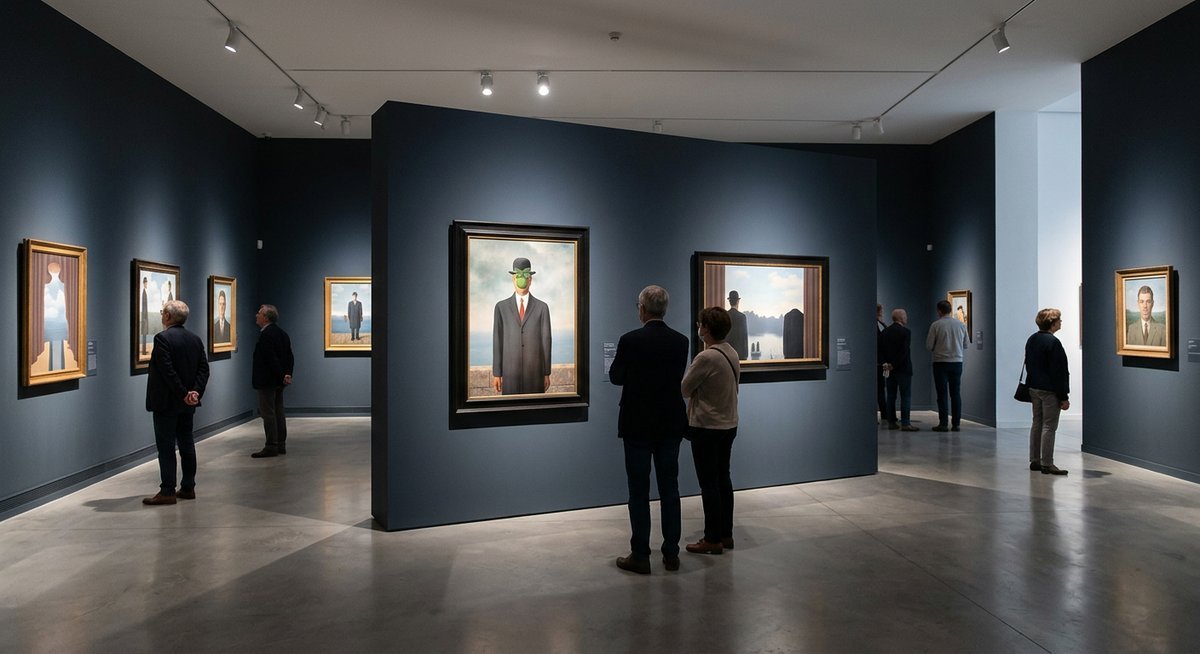
The most famous cinematic use of The Son of Man appears in the 1999 remake of The Thomas Crown Affair, directed by John McTiernan and starring Pierce Brosnan and Rene Russo. In the film’s climactic museum heist sequence, Thomas Crown evades police pursuit by flooding the Metropolitan Museum of Art lobby with dozens of lookalikes — all dressed identically in bowler hats, dark suits, and red ties, directly mimicking the figure from Magritte’s painting. The scene turned a 1964 oil painting into one of the most memorable visual gags in 1990s cinema. The stolen artwork in the film is actually a Monet, but The Son of Man provides the visual and thematic architecture of the entire escape.
Parodies, Album Covers, and Wider Influence
The painting’s template — replace the apple with something else, keep the suit and hat — has proven irresistible. Album covers, magazine illustrations, political cartoons, and advertising campaigns have all borrowed the composition. The image has appeared on The Simpsons, been recreated as street art in cities worldwide, and spawned countless Halloween costumes. In 2021, the painting briefly went viral in financial communities when investor Keith Gill (known as “Roaring Kitty”) tweeted an image of the painting, prompting r/Superstonk users to interpret the hidden face as a metaphor for concealed market positions.
Art toys and collectible figures based on the painting are sold by designers like Mighty Jaxx and KAWS-adjacent brands. The composition has also become a popular tattoo design — the suited figure with something unexpected replacing the apple.
Recreating the Son of Man: Costumes, Tattoos, and Reproductions
The Son of Man costume is among the most recognizable art-inspired Halloween outfits: a dark suit, white shirt, red tie, bowler hat, and a green apple held in front of the face (attached to a headband or wire). It works because the painting’s composition is so simple and so iconic that even a rough approximation reads immediately.
Tattoo artists frequently adapt the painting, often replacing the apple with other objects — a skull, a planet, a camera lens — while keeping the suited silhouette. The painting’s clean lines and strong contrast translate well to skin. On canvas, hand-painted reproductions range from student-quality copies to professional oil-on-linen recreations that closely match the original’s 116 x 89 cm dimensions.
The painting is not in the public domain. Magritte died in 1967, and under Belgian and EU copyright law, his works remain protected until 70 years after his death — meaning they will enter the public domain in 2038. Until then, commercial reproduction requires licensing through the Magritte Foundation or SABAM (the Belgian copyright management society).
Frequently Asked Questions
What does The Son of Man painting mean?
The painting explores the tension between what is visible and what is hidden. Magritte stated that “everything we see hides another thing” — the floating green apple obscures the face to make that philosophy literal. The meaning is not a single fixed interpretation but the permanent condition of concealment that Magritte believed defined human perception.
Who is the Son of Man painter?
Rene Magritte (1898-1967), a Belgian Surrealist painter, created The Son of Man in 1964. He is also known for The Treachery of Images (“Ceci n’est pas une pipe”) and Golconde. A different painting titled “Son of Man” was created by Norwegian painter Christian Skredsvig in 1891 and is held at the National Gallery of Norway in Oslo — the two works are entirely unrelated.
When was The Son of Man painted?
Magritte completed The Son of Man in 1964, commissioned by his friend Harry Torczyner. Some unofficial websites incorrectly list the date as 1946, but all authoritative sources — including Christie’s auction records, the Magritte Foundation, and major art encyclopedias — confirm 1964.
Where is The Son of Man painting located now?
The original painting is in an anonymous private collection and is not on permanent public display. It was last publicly exhibited at SFMOMA in San Francisco in 2018. The Magritte Museum in Brussels, which houses over 200 of his works, is the best place to see his art in person.
How much is The Son of Man painting worth?
The painting sold at Christie’s New York in 1998 for $5,392,500. Its current estimated value is significantly higher, given that Magritte’s auction record reached $79.4 million in 2022. The painting is not currently for sale. Prints and reproductions are available from under $20 to over $1,000.
Why is there an apple in front of the man’s face?
Magritte placed the apple precisely over the face to create a visual paradox: the most identity-revealing part of the portrait is the one part you cannot see. The apple does not hide the face accidentally — it draws maximum attention to the act of concealment itself.
Is The Son of Man a self-portrait?
Yes. Harry Torczyner commissioned it specifically as a self-portrait, and Magritte painted his own likeness. The deliberate concealment of the face turns it into a self-portrait that simultaneously erases the self — a contradiction that is central to the work’s meaning.
What art movement does The Son of Man belong to?
The Son of Man is a Surrealist painting. Surrealism, founded by Andre Breton in the 1920s, sought to access the unconscious mind through art. Magritte’s branch of Surrealism was distinctive for its photographic clarity and deadpan precision — ordinary objects placed in impossible contexts rather than the dreamlike distortion typical of Dali or Ernst.
What movie features this painting?
The most famous film appearance is in The Thomas Crown Affair (1999), where Pierce Brosnan’s character uses dozens of Magritte-style lookalikes in bowler hats to escape from a museum heist. The painting’s visual motif drives the entire climax sequence.
Is the pipe painting the same as The Son of Man?
No. The Treachery of Images (1929) — the painting of a pipe captioned “Ceci n’est pas une pipe” — is a completely separate work by Magritte. It is held at LACMA in Los Angeles and measures 60 x 81 cm, while The Son of Man (1964) is 116 x 89 cm and remains in a private collection. Both explore the gap between representation and reality, but they are different paintings from different decades.
The Son of Man: Why It Still Matters
The son of man painting endures because it refuses to resolve. Rene Magritte’s surrealism at its most precise: not chaos, but a calm, hyper-realistic image that makes the ordinary feel profoundly wrong. A suited man before a grey sea. A green apple where a face should be. A self-portrait that deliberately erases the self.
The bowler hat marks the figure as everyman — anonymous, bourgeois, replaceable. The apple marks the face as unknowable. Between those two gestures, Magritte captured something that has not lost its charge in sixty years: the suspicion that what we see is never the whole story, and that the most honest portrait might be the one that shows nothing at all.
Last modified: March 29, 2026