
In this environment, traditional, rigid systems don’t just fail; they actively hold us back. They are brittle, slow, and completely outmatched by the pace of modern challenges. Something has to change.
This is where Pinaflux comes in. It is a powerful conceptual framework for navigating constant change, teaching us how to build systems—in business, technology, and even our own careers—that thrive by balancing a stable, unshakeable core with dynamic, adaptive flexibility. One important clarification before we dive in: Pinaflux is a strategic concept for resilience and innovation, and it is entirely unrelated to any streaming sites or adult content. Now, let’s explore what it really means.
What is Pinaflux? Beyond the Buzzword
So, what is Pinaflux? Forget the jargon for a moment. At its heart, the concept is beautifully simple.
Pinaflux is a framework for resilience. It is built on two complementary forces: a stable, foundational core (the “Pina”) and a state of continuous, dynamic change (the “Flux”). It isn’t about choosing between stability and agility. It’s about achieving both at the same time.
Think of a massive, ancient oak tree. Its deep, unshakeable root system is its Pina—its core identity, its purpose for being. Yet, its branches, the Flux, are constantly adapting. They grow towards the sunlight, shed leaves in the winter, and bend with the wind, all without compromising the tree’s fundamental strength. That is Pinaflux in a nutshell.
This idea has conceptual roots in systems thinking, complexity science, and the hard-won lessons of digital transformation. It is a name for a pattern that successful, enduring systems have always followed—a pattern that is more relevant today than ever before.
The 4 Core Principles of the Pinaflux Framework
The Pinaflux framework isn’t just a clever idea; it is supported by four foundational pillars. These principles are the engine that allows a system to remain both stable and dynamic. Understanding them is key to putting the concept into practice.
- Adaptive Continuity: This principle is about knowing what to hold sacred and what to let go of. A Pinaflux system maintains its core identity and purpose while allowing its peripheral functions and features to evolve. The mission stays constant, even as the methods change.
- Responsive Architecture: Systems should be designed for change, not to resist it. A responsive architecture emphasizes modularity, scalability, and iterative improvement. It is like building with LEGOs instead of concrete; you can easily add, remove, or reconfigure pieces without demolishing the entire structure.
- Feedback Integration: In a state of flux, data is your compass. This principle is about building continuous feedback loops into your system. Instead of waiting for a crisis, you use a constant stream of data from customers, the market, and internal processes to make small, intelligent adjustments in real time.
- Sustainable Transformation: Growth should not create fragility. Sustainable transformation ensures that change is regenerative, not extractive. Each adaptation should strengthen the system over the long term, building resilience and capacity rather than depleting resources for a short-term gain.
Pinaflux in Action: How Giants Like Netflix and Amazon Thrive on Change
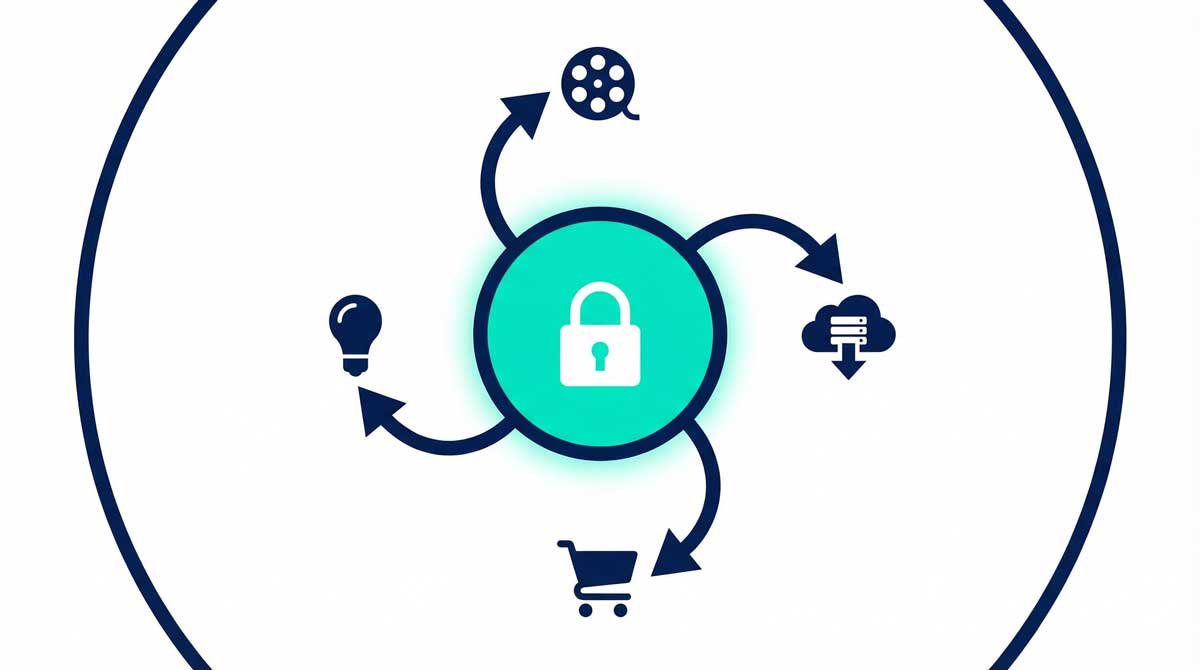
The Pinaflux framework might sound abstract, but you see it everywhere in the world’s most successful companies. They masterfully balance a stable core with relentless adaptation. This is their secret to not just surviving, but thriving in a world of constant change.
Netflix: From DVDs to Global Domination
Netflix’s Pina, its unshakable core, has always been simple: to deliver premier home entertainment conveniently. That mission has never wavered. However, its Flux is a masterclass in adaptation. It started with mailing DVDs, a revolutionary model at the time. When high-speed internet became widespread, it pivoted to streaming, disrupting its own business before anyone else could. Then, seeing the future of content, it transformed again into a global production powerhouse, creating its own original shows and films. The core mission remained; the delivery method evolved dramatically.
Amazon: The Everything Store’s Unchanging Core
What is Amazon’s core, its Pina? It is an obsessive, fanatical focus on the customer and a world-class logistics backbone. This foundation is non-negotiable. But its Flux is legendary. From this stable base, Amazon has relentlessly expanded into cloud computing (AWS), smart home devices (Alexa), streaming services (Prime Video), and even physical grocery stores. Each new venture is an adaptation, an experiment, but all are tethered to the same core principles of customer obsession and logistical excellence.
Pinaflux vs. Traditional Frameworks: A Clear Comparison
To truly grasp the power of Pinaflux, it helps to see how it stacks up against more traditional frameworks. While methodologies like Agile and Scrum are also designed for flexibility, Pinaflux operates at a more strategic, holistic level. It is less about managing a project’s workflow and more about embedding adaptability into the very DNA of a system.
| Feature | Pinaflux | Agile | Scrum | Waterfall |
|---|---|---|---|---|
| Core Philosophy | Balances a stable core identity with continuous, adaptive change at the edges. | Embraces iterative development and customer feedback through flexible cycles. | A specific Agile framework for managing complex projects in short, structured sprints. | A linear, sequential approach where each phase must be completed before the next begins. |
| Handling of Change | Change is constant, expected, and integrated into the system’s design. | Change is welcomed and managed within iterative cycles. | Change is managed at the start of each sprint; mid-sprint changes are discouraged. | Change is seen as a deviation and is costly once a phase is complete. |
| Planning Cycle | Strategic direction is long-term (the Pina), but tactical execution is in perpetual flux. | Planning is iterative and occurs throughout the project lifecycle. | Planning is done in time-boxed sprints (typically 2–4 weeks). | All planning is done upfront before any execution begins. |
| Best For | Building resilient, long-term organizational strategies and complex adaptive systems. | Software development and projects with evolving requirements. | Managing specific, complex projects with a dedicated team. | Simple, well-defined projects where requirements are fixed. |
| Key Metaphor | A tree with deep roots and ever-growing branches. | A series of short, focused journeys toward a destination. | A relay race where the baton is passed in structured intervals. | A cascading waterfall where progress flows in one direction. |
Your 5-Step Roadmap to Implementing Pinaflux
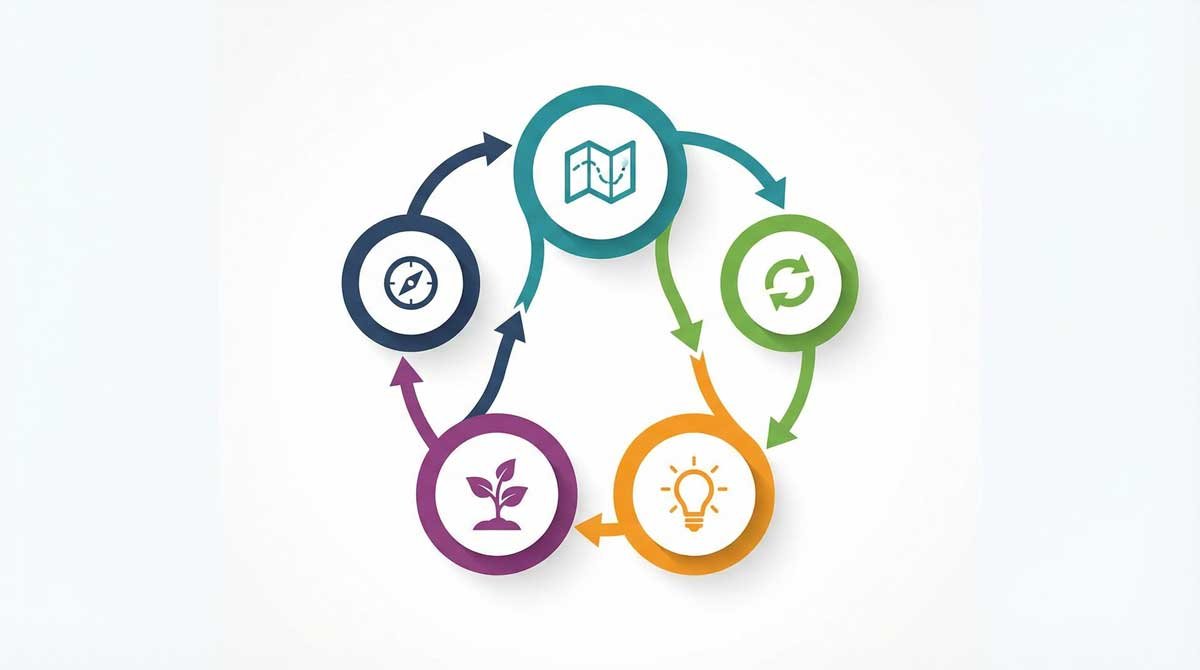
Adopting the Pinaflux mindset is a transformative journey, not an overnight switch. It requires intention, clarity, and a willingness to embrace change. This practical 5-step roadmap provides a clear path for any leader or individual looking to implement this powerful framework.
- Identify Your “Pina”: Define Your Unshakeable Core. This is the most critical step. You must clearly and honestly define your non-negotiable core. For an organization, this means your mission, your core values, and the fundamental problem you solve for your customers. For an individual, it’s your personal values and long-term purpose. Write it down. Debate it. Make it your constitution.
- Map Your “Flux” Zones: Pinpoint Areas for Adaptation. Not everything should be in flux. Identify the specific processes, products, or strategies that should be open to adaptation and experimentation. Ask your team: “If we hold our core mission constant, what are the things we could change or test to serve that mission better?”
- Establish Rapid Feedback Loops. You cannot adapt to what you cannot see. Build systems to gather, analyze, and act on data fast. This could be customer surveys, real-time analytics dashboards, weekly employee check-ins, or market trend analysis. The goal is to shorten the distance between an event and your response to it.
- Foster a Culture of Intelligent Experimentation. True adaptability requires psychological safety. Leaders must create an environment where it is safe to test, fail, learn, and iterate. Celebrate the lessons learned from failed experiments. When failure is treated as data, your team will stop fearing it and start learning from it.
- Start Small and Iterate. Don’t try to boil the ocean. Apply the Pinaflux mindset to a single, low-risk project or team first. Use it as a pilot program to learn and refine your approach. Let the success and learnings from this small-scale implementation become the catalyst that pulls the rest of the organization forward.
Beyond the Office: Applying Pinaflux to Your Personal Career Growth
The Pinaflux framework isn’t just for large organizations; it is a powerful mindset for navigating the complexities of a modern career. In an era where jobs for life are a relic of the past, your ability to adapt is your greatest asset.
Your career Pina is your core—your non-negotiable values, your innate passions, and your long-term definition of a meaningful life. This is your anchor. Your career Flux is the collection of your skills, your job titles, your industry, and even your location. These are the elements that can and should adapt over time.
Stop thinking about a linear career ladder. Instead, view your career as a portfolio of skills and experiences built around a stable core purpose. A software developer who transitions to product management isn’t abandoning their identity; they are simply adapting their skills (the flux) to better serve their core passion for problem-solving (the pina).
Here’s a practical tip: Conduct a quarterly “Pinaflux Review” of your career. Ask yourself: Am I still aligned with my core values? What skills are becoming more valuable in my field, and which are becoming obsolete? What small experiment can I run this quarter to adapt and grow?
Frequently Asked Questions About Pinaflux
1. What is pinaflux used for?
Pinaflux is used as a conceptual framework to design and manage adaptive systems. It helps organizations, teams, and individuals build resilience by balancing a stable core identity with continuous, flexible adaptation to change. It is applied in business strategy, technology architecture, organizational design, and personal career development.
2. Is pinaflux a real framework or just a buzzword?
It is a legitimate emerging concept, not just a buzzword. While it isn’t a formalized, rigid methodology like Scrum, it describes a real and observable pattern of success seen in enduring systems. Its value lies in providing a name and structure to the powerful idea of balancing stability with change, making it a practical and actionable strategic mindset.
3. How does pinaflux differ from agile methodology?
Agile is a specific methodology focused on iterative project management, particularly in software development. Pinaflux is a broader, more strategic framework. Think of it this way: Agile tells you how to run the race—in short, iterative sprints—while Pinaflux helps you decide which race to run and how to adapt your entire strategy if the finish line moves.
4. Can pinaflux be applied to personal development?
Absolutely. It is a powerful tool for career growth. Your core values and passions are your ‘Pina’ (the stable core), while your skills, job roles, and industry knowledge are your ‘Flux’ (the adaptive parts). This mindset encourages continuous learning and resilience, helping you navigate career changes without losing your sense of purpose or identity.
5. What industries benefit most from pinaflux principles?
Any industry facing high volatility and rapid change can benefit significantly. This includes technology, e-commerce, media, and financial services, where business models must constantly evolve. However, principles of adaptive leadership and resilient organizational design are becoming increasingly crucial in more traditional sectors like healthcare and education as well.
6. Is pinaflux related to pinay flix or adult content?
No, not at all. There is absolutely no relationship between the two. ‘Pinaflux’ is a strategic and organizational concept focused on systems thinking and adaptability. Any association with adult or streaming websites is purely coincidental due to keyword confusion in search engines and should be entirely disregarded.
7. How do I start implementing pinaflux in my team?
The best way to start is with Step 1 of the roadmap: clearly define your team’s ‘Pina’—its core, non-negotiable purpose. Gather your team and ask: “What is the one thing we do that will never change?” Once that is established, identify one or two ‘Flux’ zones where you can safely experiment with new processes or tools. Start small, gather feedback, and iterate from there.
Conclusion: Build for Change, Not Against It
In a world defined by relentless change, clinging to rigid, outdated systems is a recipe for irrelevance. Pinaflux offers a more resilient and powerful alternative. It is more than just a concept; it is a practical mindset for building businesses, technologies, and careers that last.
By balancing an unshakeable core with the courage to embrace continuous adaptation, you stop fighting against the current and start using it to your advantage. You build something that doesn’t just survive change, but actually gets stronger because of it.
Ready to make your organization more resilient? Start by discussing your ‘Pina’ with your team this week. What is the one core mission that will never change? Share your thoughts in the comments below.