Madsen Pirie Net Worth (2026) — The Think Tank Pioneer Nobody Can Put a Price On

Co-founding the Adam Smith Institute in 1977 helped reshape British economic policy for decades — yet Madsen Pirie does not appear on a single major net worth database. Not Celebrity Net Worth, not Wealthy Persons, not Forbes. For a man who advised Margaret Thatcher’s government, authored more than 75 books, earned an OBE, and spent 13 years as secretary of Mensa, that absence says something.
Pirie was born in Hull in 1940 and is now 85 years old. He has spent his career in the world of ideas rather than finance, which may explain why every search for Madsen Pirie net worth comes back empty. What follows covers everything publicly known about his finances, his Institute, and his remarkably prolific writing career.
Who Is Madsen Pirie?
Madsen Pirie is a British author, political theorist, and co-founder of the Adam Smith Institute (ASI), the think tank that helped shape Margaret Thatcher’s privatization agenda and remains a force in UK policy circles nearly five decades later. He has held the title of President since the organization’s founding.

Education and Early Career
Born August 24, 1940, in Kingston upon Hull, England, Duncan Madsen Pirie built an academic foundation that stretched across three institutions. He studied at the University of Edinburgh, the University of St Andrews, and Pembroke College, Cambridge. That trajectory gave him roots in both Scottish and English intellectual traditions.
Before returning to Britain, Pirie held teaching posts at Hillsdale College in Michigan and the University of Pennsylvania. Those years in American academia exposed him to the kind of free-market thinking that would later define his career back home.
He served as Secretary of Mensa for 13 years and became a member of the Mont Pelerin Society, the influential free-market academic network Friedrich Hayek founded in 1947. Membership in that society places Pirie in the company of economists and policy thinkers who reshaped Western economic orthodoxy from the postwar decades onward.
The Adam Smith Institute
Pirie co-founded the Adam Smith Institute in 1977 alongside Eamonn Butler, with Pirie serving as President and Butler as Director. The organization, headquartered at 23 Great Smith Street, London SW1P 3DJ, became one of the most influential policy shops in British history, directly shaping the Thatcher government’s privatization program throughout the 1980s.
Foreign Policy magazine ranked the ASI among the top 10 think tanks in the world outside the United States in 2010. Pirie’s policy work also earned him an OBE, and he served on the Citizen’s Charter Advisory Panel from 1991 to 1995.
Parliamentary records from TheyWorkForYou.com reference Pirie in at least seven debates between 1994 and 2018, covering healthcare, freeports, welfare reform, and pension policy. That kind of sustained presence in Hansard over two decades reflects genuine policy influence rather than media celebrity.
Madsen Pirie Net Worth Breakdown
No credible source has ever published a verified Madsen Pirie net worth figure. As president of a UK charity think tank with undisclosed funding, his compensation falls outside the public reporting requirements that apply to corporate executives or elected officials. Any figure circulating online is speculation, not fact.
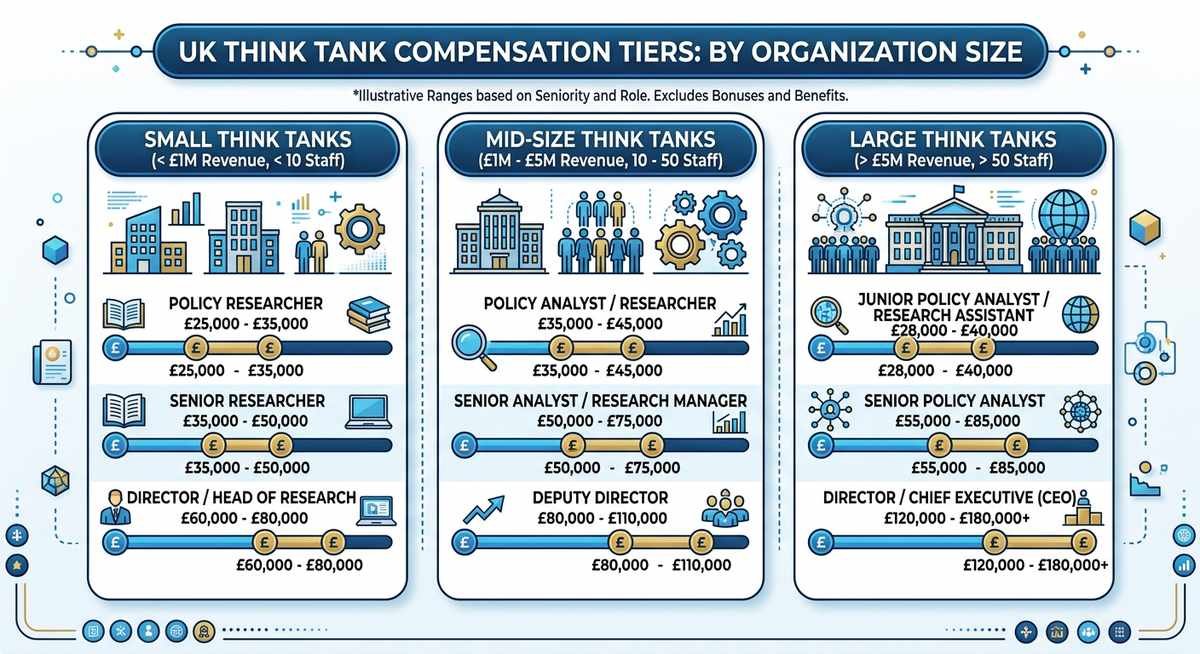
Think Tank Salary Estimates
UK think tank directors typically earn between £60,000 and £120,000 annually, based on Charity Commission filings and sector benchmarks. That range shifts considerably depending on the organization’s revenue size and whether the director role is executive or ceremonial.
The Adam Smith Institute is registered as a UK charity and files annual accounts with the Charity Commission. However, individual salaries below the reporting threshold are not itemized in those filings, which means Pirie’s personal compensation (if any) remains invisible in the public record.
His title of “President” adds another layer of ambiguity. In many think tanks, a president is an emeritus or non-executive figurehead who receives no salary at all. Whether Pirie’s role carries a paycheck has never been publicly confirmed by the ASI or by Pirie himself.
| Organization Type | Typical Director Salary (GBP) | Notes |
|---|---|---|
| Small charity think tank (under £2M revenue) | £50,000–£90,000 | Based on Charity Commission sector data |
| Mid-size think tank (£2M–£10M revenue) | £80,000–£150,000 | Includes IPPR, Policy Exchange tier |
| Large think tank (£10M+ revenue) | £120,000–£250,000 | Chatham House, RUSI tier |
The ASI’s funding sources are also opaque. Wikipedia notes the organization has received some funding from the tobacco industry, but the institute does not publish a full donor list. Its US affiliate showed approximately $1.26 million in revenue in 2015 according to InfluenceWatch. That opacity is legal for UK charities of its size, but it makes any compensation estimate even harder to anchor.
Books and Royalties
Pirie has authored approximately 75 books spanning philosophy, economics, logic, and children’s science fiction. That volume puts him well above most policy intellectuals in raw output.

Key titles include How to Win Every Argument: The Use and Abuse of Logic (2006), Think Tank: The Story of the Adam Smith Institute (2012), Economics Made Simple (2011), 101 Great Philosophers (2009), and The Neoliberal Mind. His fiction work includes Children of the Night and Dark Visitor, both published in 2007. Earlier titles like Book of the Fallacy: A Training Manual for Intellectual Subversives (1985) established his voice as a public intellectual decades before his later popular works.
UK non-fiction royalties typically run between 7.5% and 12.5% of cover price. Academic and policy books generally sell 1,000 to 5,000 copies in the UK market, which translates to modest income per title. A mid-priced book at £15 with a 10% royalty and 3,000 copies sold generates roughly £4,500.
How to Win Every Argument appears to be his commercial standout, judging by its Goodreads ratings volume relative to his other titles. A book that crosses into general readership and gets adopted by debate clubs or university courses can sustain sales for years, producing a slow but steady royalty stream. Across 75 titles and four decades of publishing, cumulative royalties could reach a meaningful sum, but that sum is impossible to calculate without sales data Pirie has never disclosed.
Speaking Fees and Other Income
Speaking fees and consulting work are plausible additional income sources for someone of Pirie’s profile. Senior policy thinkers in the UK speaking circuit typically command £2,000 to £10,000 per engagement, depending on the event and audience. Pirie does not publish rates, and no booking agency lists him publicly.
His personal blog at madsen-pirie.com and memoir archive at madsensmemories.com suggest an active public presence that is personal rather than commercial in intent. The memoir site describes “incidents, events and observations spanning early childhood through recent years,” which reads more like a passion project than a revenue-generating platform.
For a point of comparison in the nonprofit leadership space, Goodwill’s CEO compensation shows how widely nonprofit executive pay can range depending on organizational size and structure. The ASI operates at a much smaller scale than Goodwill, which sets a natural ceiling on what Pirie’s role could command.
Pirie’s Policy Legacy and Public Influence
The difficulty of quantifying Madsen Pirie net worth partly reflects the kind of career he built. His influence was measured in policy outcomes, not portfolio returns. The ASI’s privatization proposals in the 1980s touched British Rail, British Telecom, and council housing, reshaping how millions of people interacted with formerly state-owned services.
That influence extended beyond Westminster. Pirie’s approach to policy design was explicitly entrepreneurial. He treated government programs like markets to be redesigned, an approach that drew admiration from free-market advocates and sharp criticism from the left. The ASI’s work parallels a broader tradition of British institution-building that runs from policy architects to entrepreneurial disruptors like James Watt, the BrewDog co-founder who channeled a similar willingness to challenge established systems.
At 85, Pirie continues to publish through the ASI blog and maintains his memoir archive. He has not announced any retirement or succession plan for the presidency. His co-founder Eamonn Butler remains active as Director, keeping the original leadership duo intact after nearly half a century.
Why No Net Worth Figure Exists
The honest conclusion on Madsen Pirie net worth is that it is simply unknowable from public data. Estimating it would require guessing at salary, royalty history, investment assets, and property, none of which are on the public record.
This is not unusual for UK public intellectuals. Unlike American think tank leaders, who often file detailed disclosures through IRS Form 990, British counterparts at charity-registered organizations face much lighter transparency requirements. The Charity Commission requires reporting of salaries above certain thresholds, but a title like “President” can easily fall outside those bands.
Celebrity net worth databases focus on entertainers, athletes, and entrepreneurs whose income leaves visible traces through public filings, contract negotiations, and media reports. A policy intellectual who earns through a combination of charity employment, book royalties, speaking fees, and possibly no salary at all generates almost no traceable financial signal. That is why any search for Madsen net worth — whether phrased with his full name or just his surname — leads to an empty page on every major database.
Frequently Asked Questions
What is Madsen Pirie’s estimated net worth?
No verified estimate exists for Madsen Pirie’s net worth. As president of the Adam Smith Institute, a registered UK charity, his salary is not publicly reported. Based on UK think-tank compensation benchmarks of £60,000–£120,000 per year and royalties from more than 75 published books, a rough estimate might place his accumulated wealth in the low single-digit millions of pounds. That figure is speculation, not verified data, and should be treated accordingly.
What is the “Madsen price” people search for?
This search term likely conflates Madsen Pirie’s name with general pricing queries, producing results that satisfy neither intent. The Adam Smith Institute does not charge individual customers for services; it operates as a charity funded by donations and grants. Pirie’s books are available through major booksellers at standard retail prices, typically ranging from £8 to £15 for paperbacks.
How many books has Madsen Pirie written?
Madsen Pirie has authored approximately 75 books across multiple genres and decades. His works span economics (Economics Made Simple), philosophy (101 Great Philosophers), logic and argumentation (How to Win Every Argument), political theory (The Neoliberal Mind), institutional history (Think Tank), and even science fiction (Children of the Night). He also co-authored The Sherlock Holmes IQ Book with Eamonn Butler in 1996.
Is Madsen Pirie still active in 2026?
Yes, Madsen Pirie remains active at age 85. He continues to serve as President of the Adam Smith Institute and publishes through both the ASI blog and his personal memoir site at madsensmemories.com. He has not announced any retirement or succession plan, and his co-founder Eamonn Butler also remains in his role as Director.
Last modified: March 31, 2026