How to Improve Your Truck’s Handling and Stability Under Heavy Loads
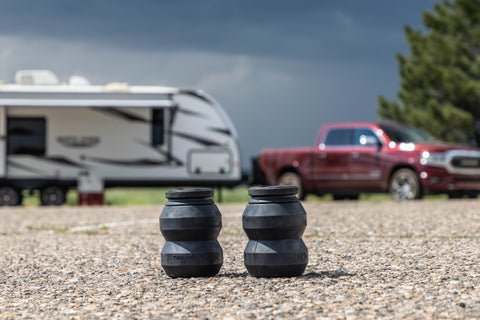
Hauling heavy loads doesn’t only strain your truck; it gradually forces every suspension and steering part to work at its maximum capacity. Factory manufacturers create designs based on an average: the typical driver, load, and road. If you frequently drive with your vehicle at the Gross Vehicle Weight Rating limit, then you are using your truck in ways that the factory parts were not designed for.
What Load Does To Your Steering Geometry
When you add significant weight to the bed or hitch, your truck’s center of gravity shifts – upward and rearward. This changes the angles at which your wheels contact the pavement, which in turn pulls your factory alignment settings out of spec.
The most common result is toe shift: your wheels start pointing slightly inward or outward compared to the direction of travel. This doesn’t feel dramatic at first. It shows up as a vague, “floaty” sensation at highway speeds, or mild resistance when you try to track straight. Over time, it chews through tires unevenly and wears steering components faster than they should.
Bump steer compounds the problem. Every time a loaded axle travels up through a pothole or road imperfection, the wheel can steer slightly without any input from you. Factory tie rod geometry was never optimized for the angles that appear under a heavy payload.
The Case Against OEM Steering Linkages
Factory tie rods and Pitman and idler arms are made to pass certification testing, not to handle emergency maneuvers at full payload. The steel used in OEM linkages is often thin enough to flex measurably under high lateral stress – the kind that happens when you swerve at speed with a loaded trailer behind you.
Flex in a steering component isn’t a minor inconvenience. It creates unpredictable lag between your input and the wheel’s response. In a normal daily driving situation, you may never notice. During an emergency correction with 10,000 pounds pushing from behind, that lag becomes dangerous.
Kryptonite steering upgrades replace undersized OEM parts with oversized, heat-treated chromoly components that eliminate steering play at the source. Where factory linkages deflect under stress, properly engineered replacements transmit driver input directly, without the elastic stretch that makes heavy trucks feel unpredictable.
Pair those with heavy-duty ball joints that have greaseable fittings. Standard sealed ball joints can’t handle the combined vertical load of a heavy payload and the lateral stress of wide or oversized tires. Greaseable units let you maintain lubrication over time rather than waiting for the factory grease to break down and the joint to seize.
Springs And Shocks Aren’t The Same Problem
Most folks think of springs and shocks as a married pair. They’re related, and they know they have a job to do, but they’re solving different problems.
Springs set ride height and determine load capacity. For trucks that see a good mix of empty and loaded work, progressive-rate springs should be in the discussion. As their name implies, linear springs compress at a steady pace. Progressive springs get stiffer as the load increases. This means your truck rides like a truck should when empty, and ramps up the support when loaded. Linear springs split the difference.
While you’re at it, you may want to add leaf spring overloads if you’re not already running them. These secondary springs do nothing until the load is sufficient to activate them. Then, they kick in to give you the extra lift exactly when you need it, without the added stiffness when you don’t.
Shocks are heat-management devices as much as they are dampers. Every component in your suspension sees increased friction when under heavy loads, and shocks are what expend that energy. Standard shocks have a limited ability to dissipate that heat. Hit a long, rough road, and they’ll “fade,” which simply means the damping ability has decreased as the fluid has heated up.
Larger-diameter shocks with remote reservoirs add fluid capacity and often put some distance between that fluid and the hot parts of the shock. It works, and it’s not just marketing snake oil. You can measure the difference on long trips.
Bushings And Anti-Roll Components
People often overlook the benefits of polyurethane bushings. Factory rubber bushings are made to absorb vibration, and they do so by allowing some flex. But that flex becomes a weakness under load. Polyurethane bushings eliminate this deflection, tightening up steering response in the process, without requiring you to touch the actual steering components.
Testing by several suspension makers has shown that upgrading from standard rubber to high-performance polyurethane or heavy-duty steel can reduce steering deflection by up to 40% when cornering under load. And that number translates directly to confidence when you need to make a correction quickly.
Sway bars and traction bars are the other half of the equation. Sway bars reduce body roll when cornering. Traction bars prevent axle wrap when you’re putting down massive amounts of torque. Like tuning the suspension for cornering, these make your truck feel more predictable in emergencies.
Heavy hauling is just downright unkind to parts engineered for lighter tasks. Addressing the physics – be it geometry, linkage strength, heat, deflection, you name it – puts that margin of safety back into components that were never meant to take the loads you’re throwing at them.
Last modified: March 24, 2026