Ali Khamenei Net Worth: Inside the $200 Billion Empire
While officially cultivating an image of a pious and ascetic leader, Iran’s late Supreme Leader, Ali Khamenei, presided over one of the world’s largest and most secretive financial empires. The striking contrast between his public persona and the vast wealth he controlled raises a critical question: What was the true net worth of Ali Khamenei?
This article delves into the scale of this fortune, estimated to be worth as much as $200 billion. We will dissect the powerful organization known as Setad, the engine of this financial empire, and explore how it systematically amassed billions through controversial means. Finally, we will examine the lingering questions about the future of this immense wealth following his death.
The Official vs. Real Net Worth: A Tale of Two Fortunes
Publicly, Ali Khamenei’s life was portrayed as one of modesty and religious devotion. His official net worth was reported to be a mere $50,000, a figure consistent with the humble lifestyle of a cleric. This narrative was carefully constructed to project an image of a leader who was above material wealth and dedicated solely to the spiritual and political guidance of the Islamic Republic.
However, behind this facade of austerity lies a starkly different reality. Investigations by news organizations and statements from government officials have revealed that Khamenei held ultimate authority over a sprawling network of assets valued between $95 billion and $200 billion. This immense fortune was not held in his personal name but was controlled through a quasi-governmental entity, allowing him to maintain a veneer of personal piety while wielding immense economic power.
“Khamenei, who often portrayed himself as living modestly, wielded sweeping political, military and economic authority. His office had the power to seize property, influence economic policy and regulate transactions in ways that, according to critics, benefited entities under his control.” — Ynetnews, March 2026
What is Setad? The $200 Billion Engine of Khamenei’s Power
The heart of Khamenei’s financial empire is a little-known organization called Setad Ejraiye Farmane Hazrate Emam—the “Headquarters for Executing the Order of the Imam.” Established by a decree from his predecessor, Ayatollah Ruhollah Khomeini, in 1989, Setad’s original mandate was to manage and sell properties abandoned in the chaotic years following the 1979 Islamic Revolution. The proceeds were intended to be used for charitable purposes, supporting war veterans and the poor, and were meant to be managed for a maximum of two years.
Instead of winding down, Setad expanded its reach exponentially under Khamenei’s leadership. It evolved from a temporary custodian of abandoned assets into a permanent and powerful business conglomerate with holdings in nearly every sector of the Iranian economy. Its interests now include real estate, finance, energy, telecommunications, pharmaceuticals, and even ostrich farming, making it a key player in Iran’s economic landscape.
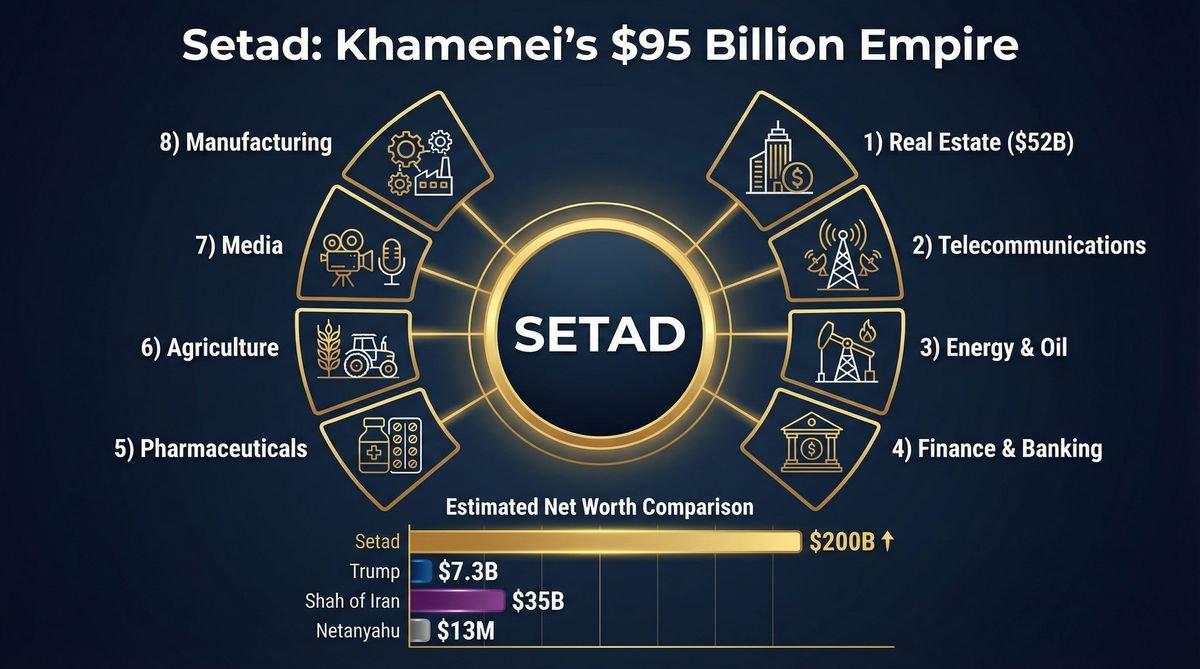
Setad’s reach spans eight major industries, from real estate and oil to pharmaceuticals and media.
How Setad Built an Empire on Seized Property
The primary mechanism for Setad’s explosive growth was the systematic seizure of real estate and other assets from Iranian citizens. A 2013 investigation by Reuters revealed how the organization used the Iranian judicial system to confiscate thousands of properties belonging to religious minorities, such as the Baha’i community, as well as expatriates and businesspeople.
The process was often ruthless. Setad would identify a property and, through the courts, claim it was abandoned or that its owners had ties to the former Shah’s regime. In many cases, these claims were false. The organization held a court-ordered monopoly on these confiscations, giving it immense power. Families were often given no recourse, and many were evicted from their homes and businesses. Once seized, the properties were either sold at auction or the original owners were forced to pay large sums to reclaim them, generating billions in revenue for the organization.
A Look Inside Setad’s $95 Billion Asset Portfolio
The 2013 Reuters investigation provided the first comprehensive look into the scale of Setad’s holdings, estimating its value at approximately $95 billion. This staggering figure was broken down into two main categories:
| Asset Class | Estimated Value (2013) |
|---|---|
| Real Estate | ~$52 Billion |
| Corporate Holdings | ~$43 Billion |
| Total | ~$95 Billion |
In the years since, U.S. officials have suggested that the total value of the network of companies and properties under Khamenei’s authority could be worth closer to $200 billion. This figure, which rivals the GDP of many nations, highlights the immense economic power wielded by the Supreme Leader, operating entirely outside the purview of the Iranian government’s official budget and parliamentary oversight.
The Khamenei Family Fortune: How Rich Are His Sons?
While the bulk of the wealth is controlled through the institutional framework of Setad, investigations have also pointed to significant personal fortunes allegedly amassed by Khamenei’s sons. This wealth is reportedly held in a complex network of overseas bank accounts and investments, separate from the main Setad empire.
| Family Member | Estimated Net Worth & Assets |
|---|---|
| Mojtaba Khamenei | ~$3 billion, plus significant holdings in gold, diamonds, and land |
| Masoud Khamenei | ~$400 million in French and UK banks, plus $100 million in Tehran and control over Renault sales in Iran |
| Meysam Khamenei | ~$200 million, with commissions from the Renault enterprise |
| Mostafa Khamenei | A cleric with less public information on his financial holdings |
These figures, though unconfirmed, paint a picture of a family that has personally benefited from the vast economic power wielded by its patriarch.
Khamenei’s Wealth vs. Other World Leaders
To put the estimated $200 billion financial empire into perspective, it is useful to compare it to the wealth of other prominent world leaders and historical figures. The sheer scale of the assets under Khamenei’s control dwarfs the fortunes of many well-known billionaires and political figures.
| Figure | Estimated Net Worth |
|---|---|
| Ali Khamenei (via Setad) | ~$200 Billion |
| Donald Trump (2025) | ~$7.3 Billion |
| Mohammad Reza Pahlavi (Shah of Iran) | ~$2–35 Billion (historical, inflation-adjusted) |
| Benjamin Netanyahu | ~$13 Million |
This comparison underscores the extraordinary concentration of economic power that was vested in the office of the Supreme Leader, rivaling and even exceeding the wealth of the monarchy that the 1979 revolution overthrew.
Sanctions, Secret Bank Accounts, and Overseas Holdings
A significant portion of the Khamenei financial empire’s activities involved moving assets and funds beyond Iran’s borders. Reports have indicated that money and other assets were funneled into a network of secret bank accounts and investments in countries such as Venezuela, the United Arab Emirates, Syria, France, and the United Kingdom.
This international network was designed to bypass international sanctions imposed on Iran. By using a web of shell companies, intermediaries, and frontmen, the organization could continue to operate and generate revenue globally, despite the economic pressure on the Iranian state. These overseas holdings not only protected the wealth from domestic instability but also provided a slush fund for the regime’s foreign policy objectives and covert operations.
What Happens to the $200 Billion Empire After Khamenei?
The death of Ali Khamenei has opened a new chapter of uncertainty for Iran, and one of the most significant unresolved questions is the future of his vast financial empire. The succession of power is not just a political and religious matter; it is also a question of who will inherit control of Setad and its $200 billion in assets.
Many analysts point to his son, Mojtaba Khamenei, as a potential key player in the future of this financial powerhouse. His alleged personal wealth and deep connections within the IRGC and the clerical establishment position him as a formidable, if controversial, figure. The struggle for control over this immense economic power will be a critical factor in shaping Iran’s future, determining the direction of its economy, and influencing the balance of power within the regime.
Frequently Asked Questions (FAQ) About Ali Khamenei’s Net Worth
What was Ali Khamenei’s official net worth?
Officially, Ali Khamenei’s personal net worth was reported to be around $50,000. He cultivated an image of a modest and ascetic religious leader.
How did Khamenei make his money?
Khamenei did not “make” money in a traditional sense. He controlled a massive economic empire called Setad, which amassed wealth primarily by seizing properties from Iranian citizens and investing in nearly every sector of Iran’s economy.
What is Setad?
Setad, or the “Headquarters for Executing the Order of the Imam,” is a powerful and secretive Iranian organization that controls assets estimated to be worth between $95 billion and $200 billion. It operates directly under the authority of the Supreme Leader.
Is Ali Khamenei the richest person in the world?
While his personal net worth was officially low, the financial empire he controlled, valued at up to $200 billion, would make him one of the wealthiest individuals on the planet if the assets were considered his own.
How much is Khamenei’s son, Mojtaba, worth?
Reports suggest that Khamenei’s second son, Mojtaba, has accumulated a personal fortune of over $3 billion, held in various overseas accounts and investments.
Where did Khamenei’s wealth go after his death?
The future of the assets controlled by Setad is uncertain. A power struggle is expected to determine who will take control of this vast financial empire, with his son Mojtaba and the IRGC being key players.
Did Khamenei own Setad personally?
No, Khamenei did not personally own Setad. It is a quasi-governmental organization, but he had ultimate authority over its operations and assets, giving him immense financial power without direct personal ownership.
What is the Execution of Imam Khomeini’s Order?
This is the full name for Setad. It was created in 1989 by Ayatollah Khomeini to manage abandoned properties, but it grew into a massive business conglomerate under Khamenei.
How does Khamenei’s wealth compare to the Shah’s?
The financial empire controlled by Khamenei, estimated at up to $200 billion, is significantly larger than the estimated wealth of the deposed Shah of Iran, Mohammad Reza Pahlavi, whose fortune was estimated to be between $2 billion and $35 billion in today’s money.
What companies does Setad own?
Setad holds stakes in a wide range of Iranian companies, spanning industries such as finance, oil, telecommunications, real estate, pharmaceuticals, and agriculture.
Conclusion
The story of Ali Khamenei’s net worth is a tale of two vastly different narratives. On the one hand, there is the carefully crafted image of a humble cleric, and on the other, the reality of a Supreme Leader who controlled a colossal, opaque financial empire. The $200 billion fortune amassed by Setad through controversial means represents a fundamental pillar of the regime’s power, operating beyond public scrutiny and fueling its domestic and international ambitions.
As Iran navigates the post-Khamenei era, the fate of this immense wealth remains one of the most critical and unresolved issues. The struggle for control of this empire will undoubtedly shape the future of the Islamic Republic, revealing the true legacy of a leader whose power was built not just on religious and political authority, but on an astonishing and deeply entrenched foundation of economic control.
References:
[1] Stecklow, S., Dehghanpisheh, B., & Yeganeh, T. (2013). Assets of the Ayatollah. Reuters.
[2] Celebrity Net Worth. (2026). Ali Khamenei Net Worth.
[3] BBN Times. (2026). Ali Khamenei’s Net Worth, Ethnicity, and Leadership.
[4] Daily Mail. (2026). How Ayatollah ran $95BILLION business empire.
[5] Avrahami, Z. (2026). Secret bank accounts and luxury real estate. Ynetnews.
Last modified: March 5, 2026