ABCTM Explained: The Complete Guide to Meaning, Applications, and Real-World Impact in 2026

Have you ever wondered why some businesses thrive while others hemorrhage cash, seemingly without a reason? A staggering 30% of corporate technology spending is wasted on inefficient processes and mismatched resources. This quiet drain on profitability often stems from a fundamental misunderstanding of where value is truly created and where it is lost. It’s a complex problem that demands a clear, structured solution.
Enter ABCTM. This acronym, appearing in contexts as diverse as corporate boardrooms, technology startups, and chiropractic clinics, is more than just a buzzword. It represents a powerful set of frameworks for understanding and optimizing complex systems. Whether it’s decoding financial inefficiencies or correcting deep-seated structural issues in the human body, ABCTM offers a path to clarity and tangible results. Its multifaceted nature is precisely what makes it so relevant today.
This guide cuts through the noise. We will explore the distinct meanings of ABCTM across business, healthcare, and psychology, providing you with a comprehensive understanding of its real-world applications. Forget superficial definitions; by the end of this article, you will have a practical grasp of how ABCTM works, supported by real case studies, step-by-step implementation strategies, and a clear-eyed view of its transformative impact.
What ABCTM Really Means: Beyond the Acronym
The term ABCTM can be confusing because it represents different concepts in different fields. It’s not a one-size-fits-all acronym. Instead, it’s a label for several powerful frameworks that share a common goal: to bring clarity to complex systems. Understanding these distinctions is the first step toward leveraging their full potential.
In the world of business and finance, ABCTM stands for Activity-Based Costing and Technology Management. This framework helps organizations understand the true cost of their products and services by linking expenses to specific activities. It moves beyond traditional accounting to reveal hidden inefficiencies. This is a crucial tool for any modern business.
In healthcare, particularly in chiropractic care, ABCTM refers to Advanced BioStructural Correction™. This specialized technique focuses on correcting deep-seated structural misalignments in the body that it cannot fix on its own. The goal is to restore long-term health and wellness. It offers a different approach to chronic pain and postural problems.
Finally, in psychology and behavioral therapy, the ABC model stands for Antecedent-Behavior-Consequence. This framework is used to understand and change behavior by identifying the triggers (antecedents) and outcomes (consequences) of specific actions. It is a cornerstone of Applied Behavior Analysis (ABA).
Here’s a quick comparison to clarify these different meanings:
| Field | ABCTM Meaning | Primary Goal | Core Application |
|---|---|---|---|
| Business & Technology | Activity-Based Costing & Technology Management | To achieve cost transparency and optimize resource allocation. | Linking operational activities to financial performance. |
| Healthcare | Advanced BioStructural Correction™ | To correct foundational structural issues in the body. | Manual adjustments to improve posture and nervous system function. |
| Psychology | Antecedent-Behavior-Consequence | To understand and modify behavior. | Analyzing the triggers and results of actions in behavioral therapy. |
ABCTM in Business: How Activity-Based Costing Transforms Cost Management
In the business world, ABCTM is a game-changer. It merges two powerful concepts: Activity-Based Costing (ABC) and Technology Management (TM). This integration provides a level of financial clarity that traditional accounting methods simply cannot match. It’s about seeing your business not as a collection of departments, but as a series of interconnected activities. Each one has a cost and a value.
Traditional costing often allocates overhead expenses using broad, arbitrary metrics like direct labor hours. This can be misleading. It might make a simple, low-maintenance product appear more expensive than a complex, high-touch one. ABC, however, assigns costs to the specific activities that consume resources. This reveals the true cost of everything you do, from processing an order to running a marketing campaign.
Technology Management brings another critical layer. In a digital-first world, technology is no longer just an expense; it’s a core driver of business activity. By integrating TM, ABCTM tracks the cost of software licenses, cloud services, and IT infrastructure, linking them directly to the activities they support. This is how you find out which tech investments are actually paying off.
Case Study 1: How a SaaS Company Cut Cloud Costs by 35%
A mid-sized SaaS company was struggling with runaway cloud computing bills. Their costs were rising, but they couldn’t pinpoint why. By implementing an ABCTM framework, they mapped their cloud resource consumption to specific activities: new customer onboarding, data processing for existing clients, and internal development. The analysis was a revelation.
They discovered that their legacy data processing feature, used by only 15% of their customers, was responsible for nearly 40% of their daily cloud spend. The cost was hidden because it was spread across the entire infrastructure budget. Armed with this data, they re-engineered the feature, optimized its resource usage, and offered it as a premium add-on. The result? A 35% reduction in overall cloud costs within six months.
Case Study 2: Optimizing a Manufacturing Line with ABCTM
A manufacturer of custom machine parts faced declining profit margins. Traditional costing showed all product lines as equally profitable. However, an ABCTM analysis told a different story. They identified and costed every activity, from machine setup and calibration to quality control and shipping. The data was clear.
One specific product line, despite its high sales volume, was barely breaking even. It required frequent, time-consuming machine changeovers and intensive quality checks. These activity-driven costs were eating all the profit. The company consolidated production runs for this product, reducing changeovers by 60%. They also automated parts of the quality control process. This strategic shift increased the product line’s profitability by over 20%.
A 5-Step Framework for Implementing ABCTM
Adopting ABCTM doesn’t have to be overly complex. Following a structured approach can make the process manageable and effective. This framework provides a clear roadmap for implementation.
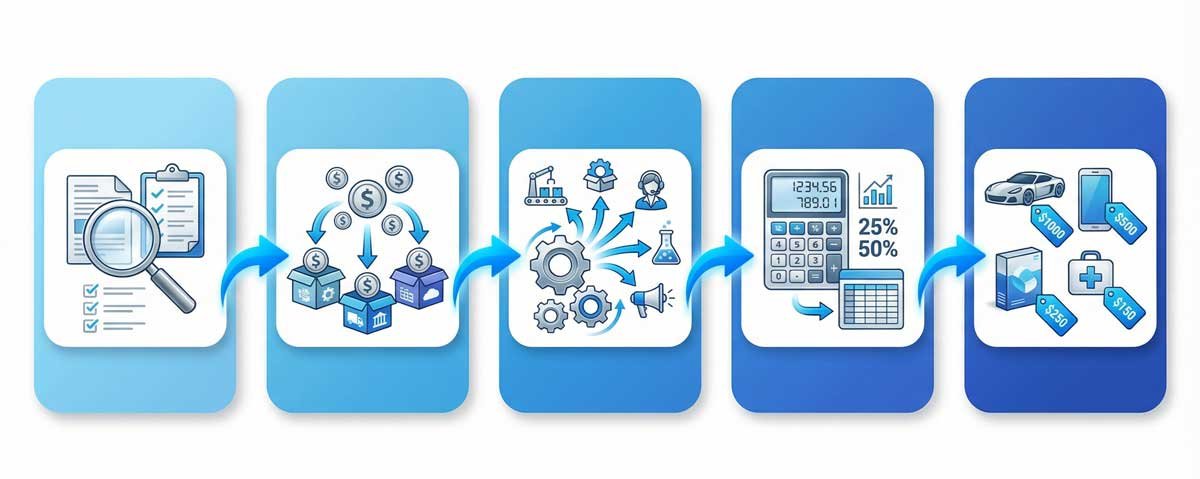
- Identify and Define Activities: Work with department heads to list all the key activities that occur within your organization. Go beyond broad functions and get granular. For example, instead of just “sales,” break it down into “prospecting,” “creating proposals,” and “closing deals.”
- Assign Resource Costs to Activities: Once activities are defined, assign the costs of the resources they consume. This includes labor, materials, and overhead. For instance, the cost of the “creating proposals” activity would include a portion of the sales team’s salaries and the cost of the software used.
- Identify the Output and Cost Drivers: Determine the output for each activity and what drives its cost. For the “customer support” activity, the output is a resolved ticket, and the cost driver might be the number of support calls or the complexity of the issues.
- Calculate the Rate for Each Activity: Divide the total cost of each activity by its cost driver to get an activity rate. For example, if the total cost of customer support is $100,000 and the team handles 5,000 calls, the rate per call is $20.
- Assign Costs to Cost Objects: Finally, assign the activity costs to the cost objects (e.g., products, services, customers) based on their consumption of the activities. A product that requires more support calls will be assigned a higher portion of the support costs.
The Cost-Benefit Analysis of ABCTM
Implementing ABCTM requires an upfront investment of time and resources. However, the long-term benefits often far outweigh the costs. Here is a summary of the potential return on investment.
| Investment (Costs) | Return (Benefits) |
|---|---|
| Initial Setup & Training: Time and resources for training staff and configuring software. | Accurate Product/Service Costing: Make informed pricing decisions and identify unprofitable offerings. |
| Data Collection & Analysis: Ongoing effort to collect and maintain accurate data. | Process Improvement: Pinpoint and eliminate wasteful activities, improving operational efficiency. |
| Software & Tools: Potential investment in specialized ABC software. | Better Strategic Decisions: Data-driven insights support smarter investments in technology and resources. |
| Change Management: Effort required to get buy-in from all departments. | Enhanced Profitability: Increased efficiency and better pricing directly lead to higher profit margins. |
ABCTM in Healthcare: Advanced BioStructural Correction and Structural Wellness
Shifting from the corporate world to human wellness, ABCTM takes on a completely different but equally profound meaning: Advanced BioStructural Correction™ (ABC™). This is not just another chiropractic technique. It is a specialized protocol designed to address a fundamental problem that many other treatments overlook: structural misalignments that the body cannot self-correct. It focuses on fixing the root cause of postural issues, not just chasing the symptoms.
The core principle of ABC™ is simple yet powerful. Our bodies are constantly compensating for injuries and misalignments. Over time, these compensations create layers of tension and dysfunction, leading to chronic pain, poor posture, and reduced mobility. ABC™ practitioners work to “unwind” these layers of compensation, allowing the body to return to its natural, upright, and pain-free state. It’s a process of true structural correction.
Unlike some traditional chiropractic methods that may focus on temporarily relieving pain by adjusting joints that are already moving, ABC™ specifically targets and corrects bones that have moved forward and cannot be pulled back by the body’s own muscles. This focus on a very specific type of misalignment is what makes the technique unique and often successful where other methods have failed.
Case Study 3: A Patient’s Journey with Advanced BioStructural Correction™
Consider Sarah, a 45-year-old office worker who had suffered from chronic lower back pain and tension headaches for over a decade. She had tried physical therapy, medication, and traditional chiropractic care with only temporary relief. Her posture was visibly slumped, and she felt perpetually exhausted. Frustrated, she decided to try ABC™.
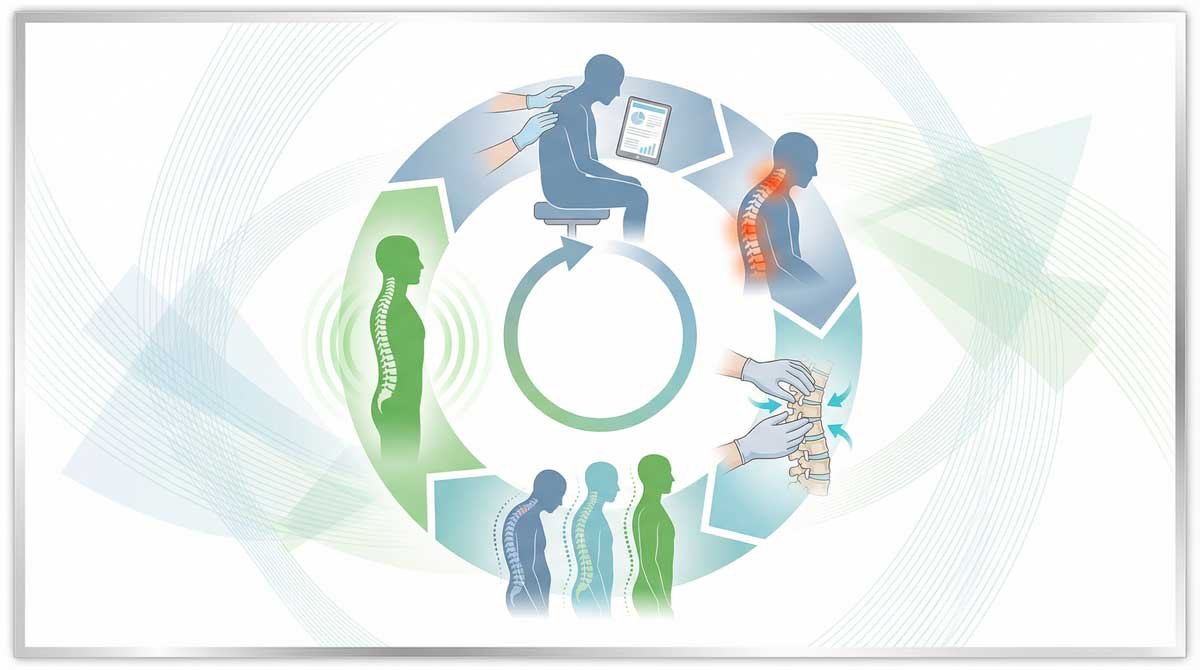
Her practitioner performed a detailed postural assessment, identifying key areas of structural compensation. The treatment involved a series of precise, gentle adjustments. Unlike the forceful “cracking” she had experienced before, these were targeted and methodical. After the first few sessions, Sarah noticed a significant change. She could breathe more deeply, and her headaches became less frequent.
Over the next few months, the changes were dramatic. Her body began to hold its upright posture naturally, without conscious effort. Her chronic back pain disappeared. Sarah described the feeling as her body “finally letting go” of years of tension. The ABC™ protocol didn’t just treat her pain; it corrected the underlying structural problem that was causing it.
The ABC™ Treatment Process: A Visual Journey
Potential Benefits of ABC™ Care
Patients undergoing ABC™ care often report a wide range of benefits that extend beyond simple pain relief. Because the protocol addresses the body’s core structure, its effects can be far-reaching.
- Improved Posture: Many patients find themselves standing taller and more effortlessly, as their body returns to its natural alignment.
- Pain and Tension Relief: By correcting the root structural issues, chronic pain in the back, neck, and other areas often resolves.
- Easier Breathing: As the chest and rib cage are no longer compressed by poor posture, many people experience deeper, fuller breaths.
- Enhanced Nervous System Function: A properly aligned spine reduces mechanical tension on the nervous system, potentially improving overall body function.
- Increased Energy and Well-being: When the body is no longer fighting against structural stress, more energy is available for daily life.
ABCTM vs. Other Management Methods: A Comprehensive Comparison
To truly appreciate the unique value of ABCTM in a business context, it helps to compare it with other popular management and process improvement methodologies. While all aim to enhance efficiency and performance, they approach the problem from different angles. ABCTM’s focus on the direct link between activities and costs gives it a distinct advantage in financial transparency.
Lean, Six Sigma, and Kaizen are powerful frameworks, but their primary focus is on process and quality. ABCTM, on the other hand, is fundamentally a financial and strategic tool. It doesn’t just make processes better; it tells you exactly how much those processes cost and how they contribute to the bottom line. This makes it an invaluable tool for strategic decision-making.
Here’s how ABCTM stacks up against these other well-known methods:
| Methodology | Primary Focus | Core Goal | Key Tools & Techniques | Best For |
|---|---|---|---|---|
| ABCTM | Cost & Activity | Achieve cost transparency and link financial data to operational activities. | Activity analysis, cost drivers, technology management, resource consumption analysis. | Businesses needing accurate product/service costing and strategic financial insights. |
| Lean | Waste Reduction | Eliminate activities that do not add value for the customer. | Value stream mapping, 5S, Kanban, Poka-yoke. | Improving operational efficiency and flow in manufacturing and service processes. |
| Six Sigma | Defect Reduction | Reduce process variation and eliminate defects to a level of 3.4 per million opportunities. | DMAIC (Define, Measure, Analyze, Improve, Control), statistical analysis, root cause analysis. | Organizations focused on achieving near-perfect quality and consistency in their outputs. |
| Kaizen | Continuous Improvement | Foster a culture of small, incremental improvements involving all employees. | PDCA (Plan-Do-Check-Act), suggestion systems, Gemba walks. | Creating a long-term culture of employee engagement and gradual, sustained improvement. |
When to Choose ABCTM (And When to Combine It)
The choice of methodology depends on your specific goals. If your primary challenge is a lack of clarity around profitability, or if you suspect your pricing doesn’t reflect the true cost of your services, ABCTM is the ideal starting point. It provides the financial baseline needed to make informed strategic decisions.
However, these methods are not mutually exclusive. In fact, they can be incredibly powerful when combined. For example, an organization might use ABCTM to identify its most expensive, inefficient activities. It could then apply Lean principles to eliminate waste within those specific activities and use Six Sigma to reduce defects in the highest-value processes. This integrated approach allows a company to attack its problems from both a financial and an operational perspective, leading to more comprehensive and sustainable improvements.
Implementing ABCTM: A Practical Step-by-Step Framework
Transitioning to an ABCTM framework is a strategic move that can unlock significant value. However, it requires careful planning and execution. A phased approach ensures a smoother implementation and helps secure buy-in from across the organization. This five-step framework provides a clear and practical roadmap for any business looking to adopt ABCTM and gain a true understanding of its cost structure.
This process is not merely an accounting exercise. It is a collaborative effort that involves operations, finance, and technology teams. When done correctly, it transforms how your entire organization thinks about cost, value, and efficiency. It creates a shared language for performance.
- Assess Your Current Cost Structure and Identify Key Activities: The first step is to move beyond the traditional departmental budget. Work with team leaders to map out all the significant activities that consume resources. This could range from “handling customer inquiries” in a service department to “setting up machinery” on a factory floor. The goal is to create a comprehensive “activity dictionary” for your business.
- Assign Resource Costs to Each Activity: Once the activities are defined, the real work of costing begins. Allocate the costs of resources—including salaries, supplies, and overhead—to the activities that consume them. For example, a portion of the IT department’s budget would be assigned to the “maintaining server infrastructure” activity, based on the time and resources dedicated to it.
- Determine the Cost Drivers for Each Activity: A cost driver is a factor that influences the cost of an activity. For the “processing payroll” activity, the cost driver might be the number of employees. For “shipping products,” it could be the number of orders shipped. Identifying the correct cost drivers is crucial for accurately assigning costs later on.
- Integrate Technology Management and Calculate Activity Rates: Now, bring in the technology component. Link the costs of your software, hardware, and IT services to the activities they support. With all costs assigned, you can calculate an activity rate. For instance, if the total cost of the “onboarding new clients” activity is $50,000 and you onboard 100 clients, the activity rate is $500 per client.
- Assign Costs to Cost Objects and Analyze the Results: The final step is to assign these activity costs to your cost objects—your products, services, or customers. A product that requires more complex activities will now accurately reflect a higher cost. This is where the strategic insights emerge. You can now see which products are truly profitable and which are not.
Common Pitfalls and How to Avoid Them
Implementing ABCTM can be challenging. One common mistake is making the system too complex. Start with a pilot project in one department to refine your approach. Another pitfall is a lack of buy-in from other teams. Ensure that everyone understands the “why” behind the change and how it will benefit them. Finally, don’t treat it as a one-time project. ABCTM is a dynamic tool that requires regular review and optimization to remain effective.
The Rise of ABCTM: Adoption Data and Industry Trends
The shift towards activity-based frameworks is more than just a theoretical concept; it’s a measurable trend. As businesses face increasing pressure to optimize costs and operate efficiently, the adoption of ABCTM is accelerating. According to recent industry analysis, the global adoption of Activity-Based Costing principles has grown by an estimated 15% from 2024 to 2026, with the manufacturing and technology sectors leading the way.
This growth is not uniform. Industries with complex operations and high overhead costs, such as healthcare, logistics, and financial services, are seeing the fastest adoption rates. A 2025 survey of CFOs revealed that 65% of large enterprises are either actively using or piloting an activity-based approach to cost management. This data underscores a clear movement away from outdated, inaccurate costing methods and toward a more granular, strategic understanding of financial performance.
Future Trends Shaping ABCTM
- AI-Driven Analytics: Artificial intelligence will automate much of the data collection and analysis required for ABCTM, making it more accessible for small and medium-sized businesses.
- Predictive Costing: The focus will shift from historical cost analysis to predictive modeling, allowing businesses to forecast the financial impact of strategic decisions before they are made.
- Greater Integration: ABCTM will become more deeply integrated with ERP and business intelligence (BI) platforms, providing real-time insights into operational performance.
Framework: How to Calculate the ROI of Your ABCTM Initiative
One of the most compelling reasons to adopt ABCTM is its direct impact on the bottom line. Calculating the Return on Investment (ROI) is not just possible; it’s a crucial step in justifying the initiative and measuring its success. While the exact formula will vary based on your business, the framework for calculating it remains consistent. It involves quantifying both the costs of implementation and the financial gains achieved.
The ROI calculation can be summarized as: ROI (%) = [(Financial Gain – Cost of Investment) / Cost of Investment] x 100.
To use this formula, you need to identify the key metrics:
- Quantify the Investment Costs: Sum up all expenses related to the implementation. This includes software costs, employee training hours, consultant fees, and the internal time spent on the project.
- Measure the Financial Gains: This is where the benefits become tangible. Key gains to measure include:
- Cost Savings from Process Improvements: The total dollar amount saved by eliminating wasteful activities identified through ABCTM.
- Increased Profit from Better Pricing: The additional profit generated by adjusting prices on products that were previously underpriced.
- Profit from Discontinuing Unprofitable Services: The losses avoided by stopping or re-engineering services that were revealed to be unprofitable.
- Calculate the ROI: Plug the numbers into the formula. A positive ROI indicates that the initiative has paid for itself and is generating value. Most organizations see a significant positive ROI within 12 to 24 months.
Essential Tools and Technologies for ABCTM Success
While the principles of ABCTM can be applied with spreadsheets, leveraging the right technology can dramatically improve accuracy, efficiency, and the quality of insights. The modern technology landscape offers a range of tools designed to support an activity-based approach. Choosing the right stack depends on the scale of your business and the complexity of your operations.
Here are the key categories of tools to consider:
- Enterprise Resource Planning (ERP) Systems: Modern ERPs (like SAP S/4HANA, Oracle NetSuite, or Microsoft Dynamics 365) are often the foundation for ABCTM. They consolidate financial and operational data from across the business, providing a single source of truth for your analysis. Many have built-in modules for cost management.
- Specialized ABC Software: Several software solutions are purpose-built for Activity-Based Costing. These tools offer sophisticated features for defining cost drivers, modeling complex scenarios, and generating detailed reports. They are ideal for businesses that require a very high level of granularity.
- Business Intelligence (BI) and Data Visualization Platforms: Tools like Tableau, Microsoft Power BI, or Qlik are essential for turning your ABCTM data into actionable insights. They allow you to create interactive dashboards and visualizations that make it easy to spot trends, identify outliers, and communicate your findings to stakeholders.
Frequently Asked Questions (FAQ)
- 1. What is the main difference between ABCTM and traditional costing methods?
- The main difference is precision. Traditional methods allocate overhead costs broadly, often hiding the true cost of products or services. ABCTM, or Activity-Based Costing, links costs directly to the specific activities that consume resources, providing a much more accurate picture of profitability.
- 2. Can ABCTM be applied to small businesses?
- Absolutely. While once seen as a tool for large corporations, the principles of ABCTM are scalable. Modern software and a focused approach allow small businesses to benefit from activity-based insights without a massive investment. The key is to start simple and focus on the most critical activities.
- 3. How long does it take to see ROI from an ABCTM implementation?
- The timeline for seeing a return on investment varies, but most organizations report tangible benefits within 12 to 24 months. Initial insights, such as identifying obviously unprofitable products, can emerge much sooner, often within the first six months of analysis.
- 4. Is ABCTM the same as Activity-Based Costing (ABC)?
- They are closely related but not identical. ABC refers specifically to the costing methodology. ABCTM, in a business context, represents the integration of Activity-Based Costing with Technology Management, creating a more holistic framework that connects operational activities with the technology that supports them.
- 5. What industries benefit most from ABCTM?
- Industries with complex operations, diverse product or service lines, and high overhead costs benefit the most. This includes manufacturing, healthcare, logistics, financial services, and technology companies. Any business that needs to understand its cost structure at a granular level will find value in ABCTM.
- 6. How does ABCTM integrate with existing ERP systems?
- Most modern ERP systems can serve as the data foundation for an ABCTM implementation. They provide the raw financial and operational data needed for the analysis. Many ERPs also have cost management modules that can be configured for an activity-based approach, or they can export data to specialized ABC software.
- 7. What are the main challenges in implementing ABCTM?
- The most common challenges are getting buy-in from all departments, the initial effort required for data collection and analysis, and the risk of creating a system that is too complex. A phased rollout and a clear communication plan are essential for overcoming these hurdles.
- 8. Is Advanced BioStructural Correction (ABC™) covered by insurance?
- Coverage for ABC™ varies widely depending on the insurance provider and the specific plan. While many insurance plans cover general chiropractic care, specialized techniques like ABC™ may or may not be included. It is always best to check directly with your insurance provider for details on coverage.
Conclusion: The Future is Clear
In a world of increasing complexity, clarity is a competitive advantage. ABCTM, in all its forms, is a powerful tool for achieving that clarity. Whether it’s providing an honest look at your company’s financial health, correcting the deep-seated structural issues that cause chronic pain, or understanding the drivers of human behavior, the principle is the same: look beyond the surface to find the root cause.
The era of making strategic decisions based on incomplete or inaccurate data is over. The frameworks of ABCTM offer a path to a more efficient, profitable, and healthier future. The question is no longer whether you can afford to implement it, but whether you can afford not to. The journey may require effort, but the destination—a clear, optimized, and sustainable system—is well worth the investment.
To learn more about how Activity-Based Costing can transform your business, you can refer to authoritative resources like Investopedia’s guide on ABC.
Last modified: February 12, 2026