5 Factors to Evaluate When Choosing Between Rafters and Trusses
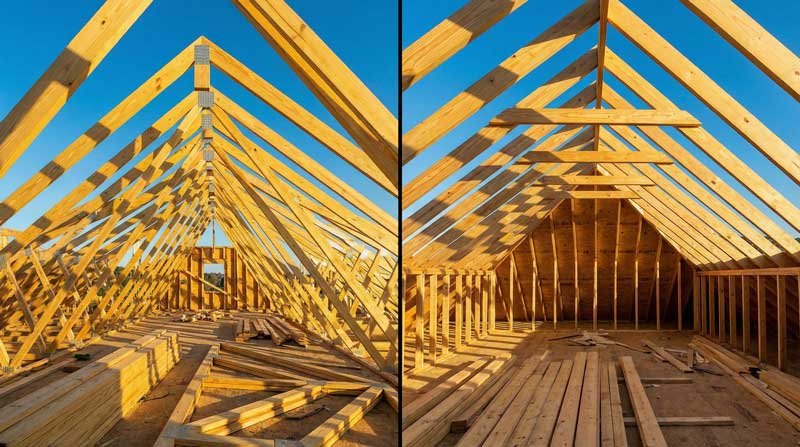
Roof framing is one of the most important structural decisions in any home build or major renovation. The right choice affects cost, timeline, design, and long-term performance. Builders and homeowners face this decision on nearly every new roof project. Each option comes with a distinct set of strengths suited to different project goals. This article breaks down five key factors to help evaluate the best roof framing method for any project.
1. Cost Difference Between Rafters and Trusses
Material cost plays a major role in roof framing decisions. The debate around rafters vs trusses almost always starts with the budget.
Trusses are prefabricated in a factory, which reduces material waste and lowers the overall price per unit.
Rafters require more raw lumber and skilled on-site labor, which adds to the total project cost.
For large-scale builds, the cost gap between the two methods becomes even more significant. Homeowners on a tight budget find that trusses deliver strong structural value at a lower price point.
2. Installation Time and Labor Cost
Speed matters on any construction job, and roof framing is no exception. Trusses arrive at the job site ready to lift and place, which cuts the total installation time by a wide margin. A crew can set trusses across a full home in a single day with the right equipment. Rafters, on the other hand, require cutting, fitting, and assembling each piece directly on the roof deck. This process demands more hours from skilled carpenters, which drives up labor costs.
3. Design Flexibility and Attic Space
Rafters offer a clear advantage when a project calls for custom roof shapes or usable attic space. Architects and builders can create vaulted ceilings, cathedral designs, and open loft areas with rafter-based framing. Trusses, due to their internal web structure, fill the attic cavity and limit how that space can be used.
4. Structural Strength and Load Support
Both framing methods can handle standard residential loads when a licensed engineer sizes them correctly. Trusses distribute weight across multiple members, which creates a strong and stable system across long spans. Rafters rely on the ridge board and wall plates to transfer load, which works well for most home sizes. A structural engineer must evaluate local snow loads, wind zones, and roof pitch before any framing method gets selected. The following points highlight key structural considerations for each method:
Trusses perform exceptionally well in areas with heavy snow loads because their triangulated design spreads force evenly.
Rafters work best on shorter spans where the structural demand stays within manageable limits.
Any roof framing system must meet local building codes, and a professional inspector must verify compliance before the project closes.
5. Long-Term Maintenance Needs
Roof framing rarely requires maintenance once a builder installs it correctly and seals it from moisture.
Rafters allow easier access to individual members, which simplifies repairs if a section sustains damage from water or pests. The open space in a rafter-framed attic makes it straightforward for contractors to inspect and treat the wood over time.
Trusses are harder to repair because cutting or altering any member compromises the entire engineered system.
The full comparison of rafters vs trusses shows that rafters hold a practical edge when long-term access and repairability matter.
Roof framing directly shapes cost, construction speed, interior design potential, structural performance, and long-term upkeep. Each project has a unique set of priorities, and no single framing method suits every situation. The smartest move is to consult a licensed structural engineer and an experienced roofing contractor before committing to a system. A professional assessment of local codes, load conditions, and design goals leads to a framing choice that serves the structure well for decades.
Last modified: May 9, 2026