Protocolo Operacional Padrão: The Definitive Guide to SOPs
Here’s a number that should make every manager pause: 67% of employees say broken company processes hold them back from doing their best work. That isn’t just frustrating for the people on the ground. It bleeds productivity, kills morale, and quietly chips away at your bottom line.
The fix isn’t some expensive software rollout or a management consulting engagement. It’s something far more fundamental. It’s called a Protocolo Operacional Padrão — or, as the rest of the world knows it, a Standard Operating Procedure (SOP).
This guide skips the textbook fluff. Instead, it delivers data-backed benefits, real-world case studies from healthcare and manufacturing, a clear comparison of commonly confused documents, and a practical framework anyone can use to build SOPs that actually get followed.
Whether you’re a startup founder trying to scale without losing quality, a hospital administrator fighting to reduce errors, or a factory manager looking to squeeze more consistency out of your production line, this guide was built for you. By the end, you’ll understand not just what a Protocolo Operacional Padrão is, but how to build one that transforms your operations from the inside out.
What is a Protocolo Operacional Padrão (SOP), Really?
Strip away the jargon and a Protocolo Operacional Padrão is simply a playbook. It’s a written document that spells out, step by step, how to perform a specific task. The goal? Make sure the job gets done right — consistently, safely, and to the same standard — regardless of who’s doing it.
The Portuguese term has gained traction worldwide, especially in industries where precision matters: healthcare, food production, pharmaceuticals, and manufacturing. But here’s where confusion creeps in. Many organizations mix up SOPs with policies, guidelines, and work instructions. They’re related, sure. But they serve very different purposes.
| Document Type | Core Purpose | Answers the Question… | Example |
|---|---|---|---|
| Policy | Sets broad guidelines and rules. | Why? | “All employees must protect company data.” |
| SOP (Protocolo Operacional Padrão) | Provides step-by-step instructions for a process. | How? | “How to back up your computer to the secure server.” |
| Guideline | Offers best practices and recommendations (flexible). | What are some good ways? | “Tips for creating strong, memorable passwords.” |
| Work Instruction | Details a single, specific step within an SOP. | How exactly? | “How to connect to the VPN client.” |
This distinction matters more than most people realize. A policy without an SOP is just a wish — a statement of intent with no mechanism for execution. An SOP without a policy lacks context and authority. And a work instruction without an SOP is a disconnected fragment that nobody knows when to apply.
In practice, these documents form a hierarchy. Policies sit at the top, setting the direction. SOPs translate that direction into repeatable action. Work instructions zoom in on the granular details of individual steps. When all three layers work together, the result is an organization where everyone — from the newest hire to the most senior manager — understands not just what to do, but why they’re doing it and exactly how to do it right.
It’s also worth noting the cultural dimension. In Brazil, where the term Protocolo Operacional Padrão originates, SOPs are deeply embedded in healthcare, public safety, and food production. The Brazilian National Health Surveillance Agency (ANVISA) mandates POPs for food service establishments, clinical laboratories, and pharmaceutical operations. This regulatory backbone has made the concept second nature in Brazilian industry — and its principles have since been adopted by organizations on every continent.
Why SOPs Are Non-Negotiable: The Data-Backed Benefits

Most articles about SOPs list vague benefits like “improved efficiency” and call it a day. That’s not good enough. The real question is: how much of a difference do they actually make? The data paints a compelling picture.
- 31% higher performance: McKinsey & Company research shows that organizations with well-defined, consistently followed SOPs significantly outperform their peers. Not by a hair — by nearly a third.
- 60% reduction in compliance risk: Deloitte reports that effective SOPs slash compliance-related risks by up to 60%. In regulated industries like finance and pharma, that’s the difference between a clean audit and a catastrophic fine.
- 25% lower employee turnover: Gallup research indicates that companies with clear processes and expectations retain employees far better. People don’t quit jobs with clarity; they quit jobs that feel chaotic.
- 30% boost in operational efficiency: Standardizing processes eliminates rework, reduces decision fatigue, and frees up resources for growth and innovation.
And here’s the cost of doing nothing. Data entry errors alone — the kind that stem directly from a lack of standardized procedures — cost U.S. businesses over $600 billion every year, according to the Data Warehouse Institute. That’s not a typo. Six hundred billion dollars, lost to preventable mistakes.
A well-implemented Protocolo Operacional Padrão attacks this waste head-on. It transforms guesswork into a system and turns potential losses into measurable gains.
Consider a practical example. A mid-sized e-commerce company processes 500 orders per day. Without a standardized picking and packing procedure, the error rate hovers around 3% — that’s 15 wrong orders daily. Each error costs roughly $25 to resolve (return shipping, replacement, customer service time). That’s $375 per day, or nearly $137,000 per year, lost to a single process that was never properly documented. One SOP could eliminate the majority of those errors within weeks.
The Anatomy of a World-Class SOP: Key Components and Formats
An effective SOP isn’t a novel. It’s not a manifesto. It’s a tool — and like any good tool, it needs to be built with precision. Every robust Protocolo Operacional Padrão shares a common set of components.
- Title and Identification: A clear title, unique ID number, version, and approval date.
- Purpose: A brief statement explaining why the procedure exists and what problem it solves.
- Scope: Defines which departments, roles, or situations the SOP covers.
- Responsibilities: Names who does what. No ambiguity allowed.
- Required Materials: Lists every tool, piece of software, or resource needed before starting.
- Procedure: The heart of the document — a step-by-step walkthrough of the task.
- Safety Warnings: Flags potential risks or hazards associated with the process.
- Revision History: A log tracking every change, who approved it, and when.
Components are only half the equation. The format matters just as much. Choose the wrong one and even a well-written SOP will collect dust. Here are the three primary formats and when to use each.
| SOP Format | Description | Best For… |
|---|---|---|
| Simple Checklist | A list of items to be completed or verified. | Short, linear tasks with no complex decisions — like equipment setup or end-of-day closing. |
| Hierarchical Steps | A numbered list with detailed sub-steps. | More complex procedures with a clear sequence that need extra detail at certain points. |
| Flowchart | A visual map of the process with decision points. | Processes with multiple possible outcomes, conditional logic, or feedback loops. |
A quick rule of thumb: if the task has fewer than 10 steps and no decision points, use a checklist. If it branches or loops, reach for a flowchart. Everything else fits the hierarchical format.
One common mistake is over-engineering the format. A simple daily equipment inspection doesn’t need a flowchart with decision diamonds and swim lanes. A checklist does the job perfectly. On the other hand, a customer complaint resolution process — with its multiple escalation paths and conditional responses — demands the visual clarity that only a flowchart can provide. Match the format to the complexity of the task, not to some corporate template mandate.
From Theory to Practice: SOPs in Action
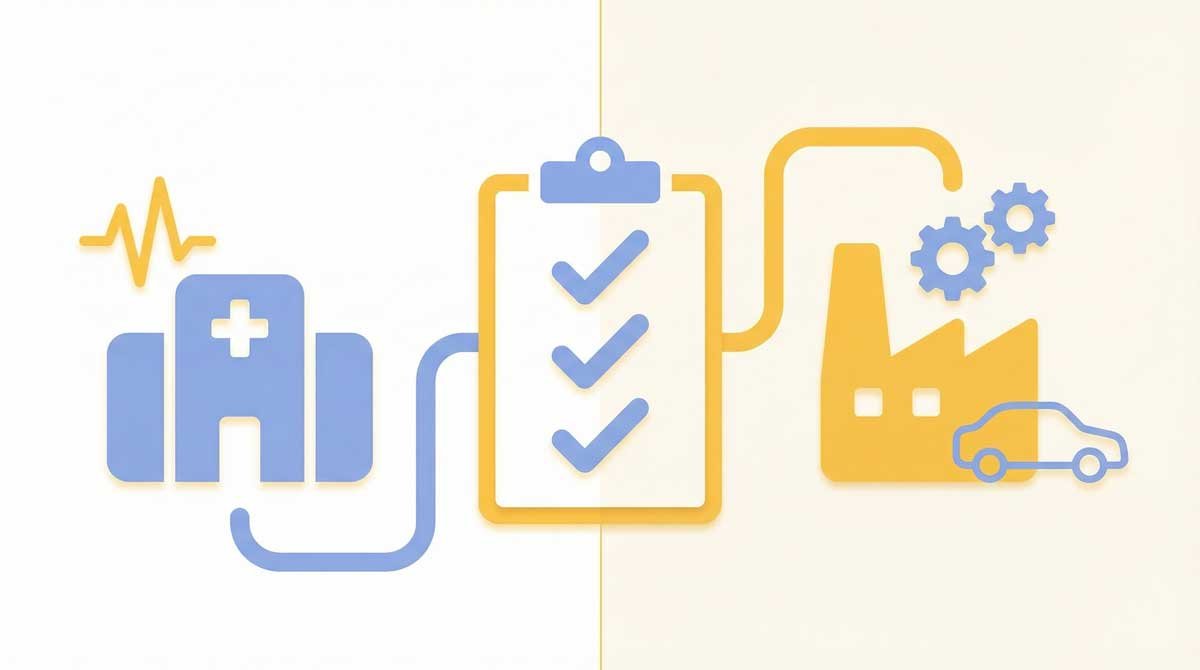
Numbers are persuasive. But stories are what stick. The true power of a Protocolo Operacional Padrão becomes vivid when you see it working in the real world — especially in environments where the stakes couldn’t be higher.
Case Study 1: Saving Lives in Healthcare
Consider ABC Medical Center, a Florida-based hospital that was struggling with long patient wait times and a troubling rate of medication errors. The root cause wasn’t a lack of talent or resources. It was inconsistency. Different nurses, different shifts, different approaches to the same critical tasks.
By implementing a comprehensive system of SOPs across their departments, the results were dramatic. Patient wait times dropped significantly. Medication administration errors decreased. Patient satisfaction scores climbed. The lesson is clear: in healthcare, standardization doesn’t stifle care — it protects it.
This mirrors the critical role of the Protocolo Operacional Padrão within Brazil’s SAMU (Serviço de Atendimento Móvel de Urgência), the country’s unified emergency medical service. From triage protocols to ambulance dispatch procedures, every step is documented. In emergencies, there’s no time to improvise. The SOP is the lifeline.
Case Study 2: The Gold Standard in Manufacturing
The modern SOP owes a deep debt to the Toyota Production System (TPS). At Toyota, SOPs are called “Standardized Work,” and they aren’t just documentation — they’re the foundation of everything. Every task on the assembly line has one documented best method. Workers follow it precisely.
But here’s the insight most people miss: standardization at Toyota isn’t about rigidity. It’s about creating a stable baseline for continuous improvement, or Kaizen. You can’t improve what you haven’t defined. Without a documented Protocolo Operacional Padrão, every “improvement” is just a guess.
This principle extends far beyond automotive manufacturing. Restaurants use SOPs to ensure every dish tastes the same whether it’s made by the head chef or a new line cook. Airlines rely on them to guarantee that pre-flight safety checks happen identically on every aircraft, every time. Software companies use them to standardize deployment procedures, reducing the risk of costly production outages. The industry changes; the principle doesn’t.
The Future is Digital: SOPs in the Age of AI and Automation
Dusty binders on a shelf. Laminated sheets taped to a wall. That era is ending fast. The future of the Protocolo Operacional Padrão is digital, dynamic, and increasingly intelligent.
Organizations worldwide are migrating to digital SOP platforms that offer real-time access on any device, version control, interactive checklists, and analytics that track whether procedures are actually being followed. This isn’t a nice-to-have anymore. It’s becoming the expectation.
The rise of AI adds another layer. Modern tools can now help draft SOPs from process descriptions, flag outdated procedures, and even suggest optimizations based on performance data. Some platforms now offer video-based SOPs, where employees can watch a short clip of the correct procedure rather than reading a text document. Others integrate with IoT sensors on the factory floor, automatically triggering the relevant SOP when a machine enters a specific state.
The SOP is evolving from a static document into a living, breathing part of the daily workflow. For teams still relying on Word documents and PDF printouts, the gap between their approach and what modern digital SOP platforms offer is growing wider every quarter.
For organizations pursuing formal quality certifications, this matters even more. SOPs are a cornerstone of ISO 9001, the internationally recognized standard for quality management systems. ISO 9001 requires documented processes, defined responsibilities, and evidence of continuous improvement — all of which a well-crafted Protocolo Operacional Padrão delivers.
Beyond ISO, regulatory bodies across industries increasingly expect documented procedures. The FDA requires SOPs for pharmaceutical manufacturing and medical device production. OSHA expects them for workplace safety protocols. Financial regulators demand them for anti-money laundering and know-your-customer processes. In each case, the Protocolo Operacional Padrão isn’t just a best practice — it’s a legal and regulatory necessity.
How to Write an SOP That People Actually Use: A 5-Step Guide
Knowing what an SOP is and knowing how to build one that actually gets used are two very different things. Most SOPs fail not because they’re poorly written, but because they were created in a vacuum. Here’s a practical, five-step process that avoids that trap.
- Identify and Prioritize. Don’t try to document everything at once. Start with the process that causes the most confusion, the most errors, or the biggest customer complaints. Ask your team one question: “If we could standardize just one thing, what should it be?” Prioritize based on impact: high-risk processes, customer-facing tasks, and anything that involves regulatory compliance should move to the top of the list.
- Gather the Experts. The people who perform the task daily are the real subject matter experts — not the managers watching from a distance. Involve them from day one. This ensures accuracy and builds the buy-in you’ll need for adoption.
- Draft and Simplify. Write in plain language. Use the active voice. Keep sentences short. Add screenshots or photos where they help. The ultimate test: hand the draft to a new hire. If they can follow it without asking questions, you’ve nailed it.
- Review and Test. Have someone unfamiliar with the process attempt to follow the SOP step by step. Where did they hesitate? What confused them? This feedback is gold. Use it to refine every unclear instruction.
- Train, Implement, and Schedule Reviews. Roll out the SOP with formal training. Then — and this is the step most organizations skip — schedule regular reviews. Quarterly or annually, revisit each SOP to ensure it reflects current tools, regulations, and best practices. A stale SOP is a dangerous SOP.
Common Pitfalls to Avoid
Even well-intentioned SOP projects can fail. Here are the most common traps that derail the process:
- Writing in isolation. An SOP drafted by a manager who hasn’t performed the task in years will miss critical steps. Always involve the frontline workers.
- Making it too long. A 20-page SOP for a 5-minute task is a guaranteed shelf-warmer. Be ruthless about brevity. If a step doesn’t add value, cut it.
- Skipping the testing phase. The single biggest predictor of SOP failure is skipping the real-world test. If nobody tries to follow it before launch, you’re deploying an untested product.
- Never updating. Processes evolve. Technology changes. Regulations shift. An SOP that was perfect two years ago may be actively harmful today if it hasn’t been reviewed.
- Burying it in a shared drive. Accessibility matters. If people can’t find the SOP in under 30 seconds, they won’t use it. Make SOPs visible, searchable, and easy to access from any device.
FAQ: Your SOP Questions, Answered
- 1. What is a Protocolo Operacional Padrão (POP) in simple terms?
- A Protocolo Operacional Padrão is a detailed, step-by-step guide that explains exactly how to perform a specific task. Its purpose is to ensure the task is done correctly and consistently every single time, regardless of who performs it. Think of it as a recipe — but for a business process.
- 2. Is a POP the same as an SOP?
- Yes, they are identical in concept. “Protocolo Operacional Padrão” (often abbreviated as POP) is the Portuguese term for what English speakers call a Standard Operating Procedure (SOP). The purpose, structure, and function are the same.
- 3. What is the most important difference between an SOP and a policy?
- A policy defines the rule — the “why.” An SOP explains the process to follow that rule — the “how.” For example, a company policy might state “All customer data must be kept secure.” The corresponding SOP would detail the exact steps to encrypt, store, and back up that data.
- 4. Do small businesses really need SOPs?
- Absolutely — and arguably more than large enterprises. When a small business grows, the founder can no longer oversee every task. SOPs capture the knowledge and quality standards that made the business successful, ensuring they scale with the team rather than getting lost in the shuffle. They also make the business more valuable: potential investors and acquirers look favorably on companies with documented, repeatable processes.
- 5. How often should we review our SOPs?
- At a minimum, review every SOP annually. But don’t wait for the calendar. Update immediately whenever a process changes, new technology is adopted, or a regulation shifts. The most dangerous SOP is an outdated one that people still follow. Many organizations assign a “process owner” to each SOP who is responsible for monitoring relevance and triggering updates when needed.
- 6. Who is responsible for writing SOPs in a company?
- The best SOPs are a team effort. A process owner or manager should lead the project, but the employees who actually perform the work must be deeply involved. They know the real steps, the common pitfalls, and the shortcuts that actually work. In larger organizations, a dedicated quality assurance or process improvement team often coordinates SOP development across departments to ensure consistency in format and terminology.
- 7. What are the three main formats for an SOP document?
- The three most common formats are: (1) a simple checklist for basic, linear tasks; (2) a hierarchical step-by-step guide for more complex procedures; and (3) a flowchart for processes that involve decision points, branching paths, or multiple possible outcomes.
Conclusion: Your Blueprint for Operational Excellence
A Protocolo Operacional Padrão is not red tape. It’s not bureaucracy for the sake of bureaucracy. It is the deliberate act of defining what “excellent” looks like — and then making that the standard, every single time a task is performed.
Organizations that embrace documented, standardized processes don’t just run more smoothly. They build resilience. They scale faster. They retain better talent. And they turn hard-won operational knowledge into a durable competitive advantage that no competitor can easily replicate.
The starting point is simple. Pick one process — the one that causes the most confusion, the most rework, or the most customer complaints. Apply the five-step guide from this article. Document it. Test it. Improve it. That single act is the first step toward building a business that runs on a blueprint, not on guesswork.
Because in the end, the organizations that win aren’t necessarily the ones with the best ideas. They’re the ones that execute their ideas consistently, reliably, and at scale. And that starts with a single, well-written Protocolo Operacional Padrão.
Last modified: February 25, 2026