Self-Cleaning Street Lamps: Do These Projects Really Exist?
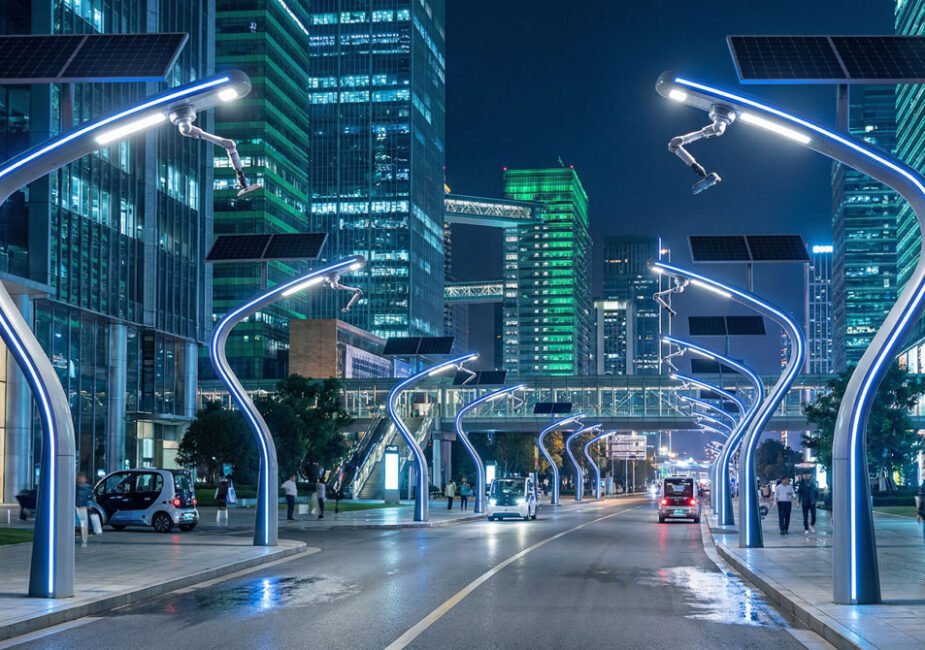
Did you know that a nearly invisible layer of dust can slash a street lamp’s brightness by up to 50%? This silent dimming doesn’t just waste energy; it subtly compromises the safety of our streets every single night.
For cities, this creates a relentless, costly battle. Imagine the logistical nightmare and staggering expense of manual cleaning millions of street lamps, especially in regions plagued by dust storms or heavy pollution. It’s a never-ending cycle of labor, resources, and budget strain.
But what if streetlights could clean themselves? This article dives into the world of self-cleaning and dust-resistant lamp projects. We’ll explore whether this technology is science fiction or a present-day reality, how it works, its surprising economic benefits, and its pivotal role in building the autonomous smart cities of tomorrow.
What Are Self-Cleaning Street Lamps, and Do They Really Exist?
Let’s cut through the jargon. A self-cleaning street lamp is an advanced lighting fixture engineered to automatically remove dust, dirt, and other debris from its surfaces without human intervention. It’s not a futuristic concept; it’s a tangible technology that is actively being deployed.
The technical-sounding phrase, “self cleaning street lamp research dust resistant lamp project exist,” points to a crucial stage in innovation. It signifies that the technology has moved beyond theoretical research and has been validated through proof-of-concept projects. These projects confirm that a scalable, reliable solution can and does exist for real-world conditions.
Today, these advanced lamps are illuminating highways in the Middle East, industrial zones in Asia, and as part of integrated smart city lighting solutions across the globe. They have officially graduated from the laboratory to the lamppost.
The Silent Killer: How Dust Cripples Lighting Efficiency and Budgets
Dust is more than a minor nuisance; it’s a silent saboteur of urban infrastructure. The process, known in the industry as “soiling,” involves the gradual accumulation of airborne particles—dust, industrial pollutants, pollen, and salt spray—onto lamp surfaces. This creates an opaque film that can block a startling amount of light.
Research consistently shows that this layer of grime can reduce a street lamp’s light output by 40% to 50% in just a few months, particularly in arid or industrial regions [1]. This isn’t just a dimming issue; it’s a domino effect of escalating problems. Public safety is compromised as streets and public spaces become dangerously underlit, potentially leading to increased accidents and crime.
Furthermore, the financial implications are staggering. To compensate for the reduced brightness, cities might be forced to use higher-wattage bulbs, driving up energy consumption. The constant buildup of heat-trapping dust also puts thermal stress on sensitive electronic components, shortening the lamp’s operational lifespan. This all culminates in the immense, recurring expense of automatic street light maintenance—a costly, labor-intensive, and often hazardous task that drains municipal budgets.
Under the Hood: The Science Behind Dust-Resistant Technology
Self-cleaning street lamps combat the problem of soiling through a sophisticated, multi-layered approach. By combining passive resistance with active cleaning and intelligent automation, they create a system that is both resilient and efficient. This technology isn’t monolithic; it’s an elegant integration of material science, mechanical engineering, and smart electronics.
The First Line of Defense: Advanced Surface Engineering
The first strategy is to prevent dust from sticking in the first place. This is achieved through passive, ‘always-on’ surface technologies. Lamp housings and the glass or polycarbonate lenses are treated with special nano-coatings that dramatically alter their surface properties.
These are often hydrophobic coating for solar panels and lighting, which are water-repelling, and oleophobic (oil-repelling) coatings. Much like how a lotus leaf causes water to bead up and roll off, these engineered surfaces have a microscopic texture that minimizes the contact area for dust and grime particles. Other advanced coatings are photocatalytic self-cleaning surfaces, like those using Titanium Dioxide (TiO₂). When exposed to UV light from the sun, these surfaces actively break down organic dirt, which can then be washed away by rain [2].
The Heavy Lifters: Active Self-Cleaning Mechanisms
For stubborn dust accumulation, especially in dry regions with no regular rainfall, passive coatings are paired with active cleaning systems. These are the mechanical workhorses that physically remove debris on a schedule or as needed.
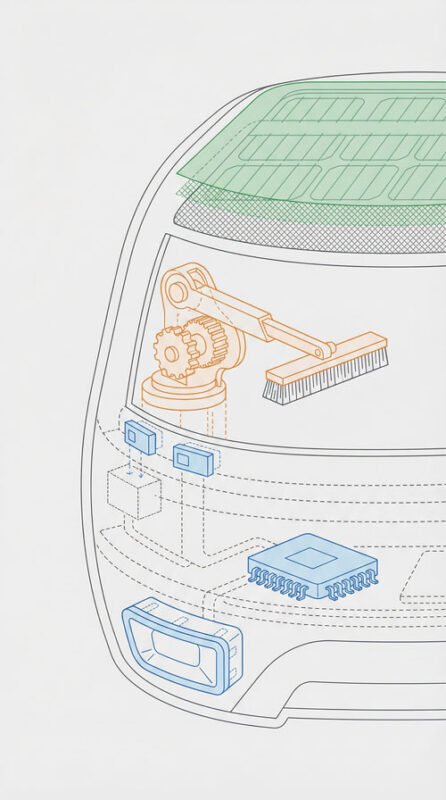
One of the most common designs is a miniature, robotic wiper system. A small, motorized arm with a durable brush or squeegee sweeps across the surface of the lamp or its integrated solar panel, physically pushing dust away. Another innovative method is vibration-based shedding, where high-frequency, low-amplitude sonic vibrations are sent through the lamp’s surface, effectively shaking the dust particles loose so they can be carried away by the wind.
The Brains of the Operation: Smart Sensors and IoT Control
What makes modern systems truly ‘smart’ is their ability to clean only when necessary. This is where IoT street light management comes in. The lamps are equipped with a suite of sensors that act as their eyes and ears.
Optical dust sensors can measure the amount of particulate matter accumulating on the surface, while Light Dependent Resistors (LDRs) can detect a drop in the actual light output. This data is fed to an onboard microcontroller. When the dust level crosses a pre-defined threshold, the controller automatically triggers a cleaning cycle. This sensor-driven approach is far more efficient than a simple timer, as it conserves energy and reduces mechanical wear.
From Lab to Lamppost: A Timeline of an Innovation
The journey of the self-cleaning street lamp wasn’t an overnight breakthrough. It was a gradual evolution, built upon decades of research in material science, robotics, and smart technology. Understanding this timeline reveals how different fields converged to create the robust solutions we see today.
- Early 2010s: Initial academic research into photocatalytic and hydrophobic coatings.
- Mid-2010s: Development of the first mechanical cleaning prototypes for solar panels.
- Late 2010s: Integration of IoT sensors and smart controls; first pilot projects emerge.
- Early 2020s: Commercial products become available, with deployments in the Middle East.
- Present Day (2026): Focus on AI-driven predictive cleaning and integration into city-wide smart grids.
The Economics of Illumination: A Cost-Benefit Analysis
While the advanced technology in self-cleaning street lamps commands a higher upfront price, viewing it as a simple expense is shortsighted. A proper cost-benefit analysis reveals that these systems are not a cost, but a long-term investment with a compelling return on investment (ROI). The economic case is built on a dramatic reduction in operational expenditures over the lamp’s lifespan.
To truly understand the financial shift, a direct comparison is essential. The table below breaks down the key economic differences between traditional and self-cleaning street lamp models.
| Feature | Traditional Street Lamp | Self-Cleaning Street Lamp |
|---|---|---|
| Initial Cost | Low | High |
| Maintenance | High (Frequent manual cleaning) | Very Low (Automated) |
| Energy Efficiency | Decreases over time as dust accumulates | Consistently High |
| Lifespan | Shorter (due to heat/dirt stress) | Longer (protected components) |
| Operational Cost (15-Year) | Very High | Very Low |
| Safety & Performance | Degrades between cleanings | Stable and Reliable |
A city can calculate its specific payback period by modeling these factors. The formula involves dividing the initial extra cost of the smart lamps by the annual savings from eliminated labor, reduced energy consumption, and lower replacement frequency. For many municipalities, this calculation reveals a payback period of just a few years.
Real-World Deployments: Where Are These Lamps Shining Today?

Self-cleaning street lamp projects have moved far beyond the blueprint stage and are now enduring some of the most challenging environments on Earth. These real-world deployments serve as living laboratories, proving the technology’s resilience.
The Middle East, with its ambitious smart city goals and harsh desert climate, has become a primary hub for this technology. In the United Arab Emirates (UAE) and Saudi Arabia, self-cleaning solar street lights are being installed along remote highways that stretch for hundreds of kilometers through the desert.
Futuristic mega-projects like NEOM in Saudi Arabia are integrating this technology at their core. For a city being built from the ground up on principles of sustainability and automation, self-maintaining infrastructure is not a luxury but a necessity. These self-cleaning lamps are part of a larger, interconnected IoT network, contributing to a Smart City [3] that runs with maximum efficiency.
FAQ: Answering Your Questions
- 1. How effective are self-cleaning mechanisms in reality?
- They are highly effective. Depending on the specific technology and environment, studies and real-world deployments show a dust reduction of 60% to over 90%. This is enough to keep light output and solar panel efficiency at consistently high levels.
- 2. Is this technology suitable for solar-powered street lights?
- It is not just suitable; it is essential for them. Solar street lights are entirely dependent on their panels for power. By keeping the panels free of dust, the self-cleaning mechanism ensures the battery receives a full charge daily, which is critical for reliable, all-night operation.
- 3. What is the biggest technical challenge for these projects?
- The primary challenge is perfecting the balance between cleaning effectiveness and energy consumption. The cleaning system must be powerful enough to remove stubborn grime but efficient enough that it doesn’t significantly drain the lamp’s battery reserves.
- 4. What is the actual cost difference compared to traditional lamps?
- The initial purchase price of a self-cleaning lamp can be significantly higher than a traditional one. However, the total cost of ownership is much lower. When you factor in the elimination of manual cleaning costs, lower energy waste, and a longer operational lifespan, the return on investment is often realized within just a few years.
- 5. How often do the self-cleaning parts need maintenance?
- The cleaning mechanisms themselves are designed for longevity and minimal maintenance. The motors and brushes are typically rated for thousands of cleaning cycles, translating to many years of service. While periodic inspections are recommended, they require far less attention than the constant cleaning schedule of traditional lamps.
The Bright Future of Autonomous Urban Infrastructure
The self-cleaning street lamp is more than just a clever piece of engineering; it represents a fundamental shift in how we manage our cities. By automating a critical maintenance task, this technology delivers a powerful trifecta of benefits: immense long-term cost savings, consistently safer streets, and a significant step towards sustainable urban environments.
These dust-resistant projects, which now demonstrably exist, are a preview of the future. The self cleaning street lamp research dust resistant lamp project exist as a testament to the power of integrated technology. They are a key component in the development of the autonomous city—an urban ecosystem that can monitor and maintain itself. The future isn’t just bright; it’s smart and self-sufficient.
References
[1] NREL (National Renewable Energy Laboratory). “Soiling Energy Losses.” Research data on photovoltaic performance degradation due to environmental factors.
[2] Wikipedia. “Photocatalysis.” An overview of the process where a light-activated substance modifies the rate of a chemical reaction.
[3] Wikipedia. “Smart city.” A framework of using information and communication technologies to create, deploy and promote sustainable development practices to address growing urbanization challenges.
Last modified: January 13, 2026