Revolt Chat: The Open-Source Discord Alternative

Revolt Chat surpassed 600,000 registered users before rebranding to Stoat.chat in early 2025 — making it the largest open-source Discord alternative that actually ships a usable product, not just a GitHub README. Created by developer Paul Makles in 2021, the platform delivers servers, text channels, voice chat, roles, and permissions without charging a cent or harvesting behavioral data.
The entire codebase sits on GitHub under the AGPL-3.0 license. Anyone can audit it, fork it, or deploy a private instance on their own infrastructure. That transparency is the core value proposition, and it separates Revolt Chat from every proprietary messaging platform on the market — Discord included.
Community owners migrating from Discord find familiar structure without the Nitro paywalls. Privacy-conscious teams get a self-hosted chat application where messages never leave their servers. Developers get a Rust-powered backend they can extend, customize, and contribute to. The platform serves all three audiences without forcing any of them to compromise.
What Is Revolt Chat and How Does It Work?
Revolt Chat is a free, open-source messaging platform that organizes communities into servers with text channels, voice channels, roles, and granular permissions — structurally identical to Discord, but with zero subscription fees, zero ads, and a fully public codebase anyone can inspect.
Paul Makles built the first version in 2021 as a collaborative project, and it grew fast. By June 2023, Revolt Chat hit 100,000 registered users. By October 2024, that number crossed 500,000. The platform now operates under the Stoat.chat rebrand with over 600,000 accounts, according to the official Stoat.chat about page.
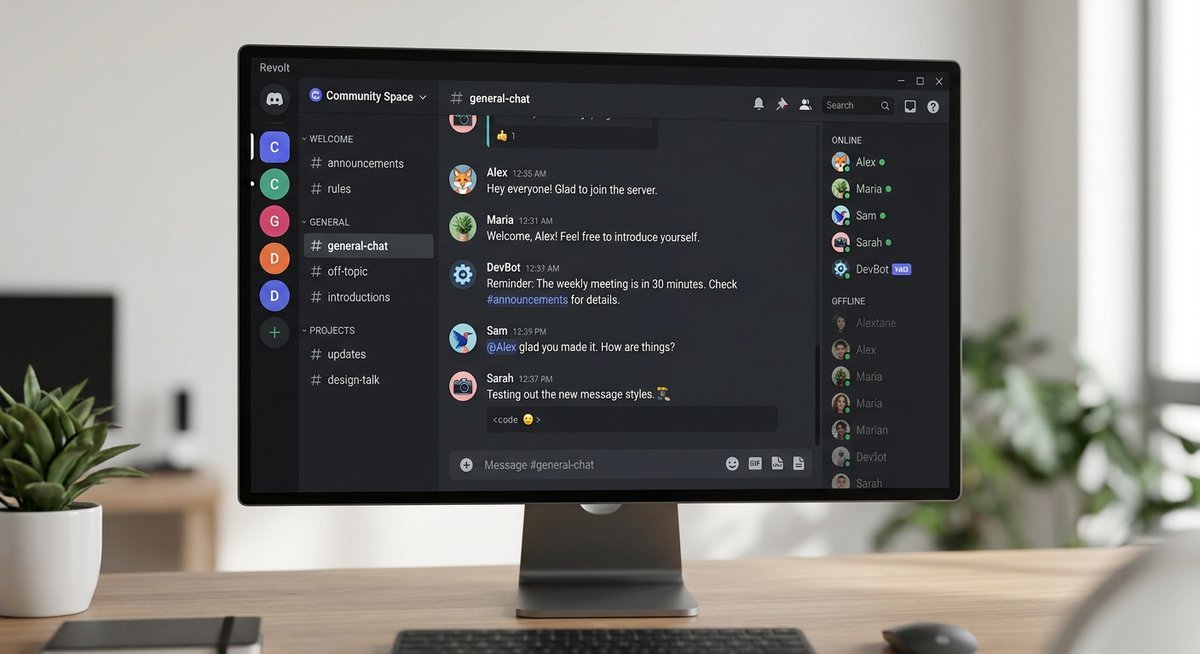
Revolt Chat Features and Platform Overview
Every feature ships free. Text channels support Markdown formatting, custom emoji, file attachments up to 20 MB, and GIF search via Tenor integration. Voice channels handle real-time audio communication. Server administrators get a full role-based permissions system — the same hierarchical structure Discord users already know.
Revolt Chat also supports direct messaging, group DMs, user profiles with custom badges, and a unique feature called Masquerade that lets users change their display name and avatar per-message inside supported servers. The file upload limit sits at 20 MB for standard attachments, with smaller caps for avatars (4 MB) and emoji (500 KB).
From Revolt to Stoat: What Changed?
The platform rebranded from Revolt Chat to Stoat.chat in early 2025. Paul Makles and the core team remain the same. The GitHub organization migrated from revoltchat to stoatchat, and revolt.chat now redirects to stoat.chat permanently. The underlying architecture, community servers, and self-hosting documentation all carried over unchanged.
“Revolt Chat” still dominates search traffic, so both names refer to the same project lineage. The Stoat rebrand represents continuity, not a pivot — same open-source philosophy, same AGPL-3.0 license, same commitment to privacy-first community server software.
Revolt Chat vs Discord: Feature-by-Feature Comparison
Revolt Chat matches Discord on core messaging features while beating it on price, privacy, and data ownership. Discord’s advantage is ecosystem maturity, and the detailed Revolt Chat vs Discord comparison breaks down every dimension — a decade of third-party integrations, polished mobile apps, and a massive bot library. The tradeoff is convenience versus control.
Side-by-Side Comparison Table
| Feature | Revolt Chat (Stoat) | Discord |
|---|---|---|
| Price | 100% free — no subscription tiers | Free tier + Nitro from $9.99/month |
| Open Source | Yes — AGPL-3.0, fully auditable | No — proprietary codebase |
| Self-Hosting | Yes — Docker, Kubernetes supported | No — cloud-only |
| Data Ownership | Full control on self-hosted instances | Data held by Discord Inc. |
| Backend Tech | Rust microservices + MongoDB | Proprietary (Elixir-based) |
| Voice & Video | Voice channels available | Voice, video, screen share, Go Live |
| File Upload Limit | 20 MB (all users) | 25 MB free / 500 MB with Nitro |
| Bot Ecosystem | Growing — revolt.js and revolt.py APIs | Massive — thousands of verified bots |
| Mobile Apps | Android (stable), iOS (TestFlight beta) | iOS and Android — fully featured |
| Ads & Tracking | None | Behavioral data collection active |
Where Revolt Chat Wins (and Where It Still Lags)
Revolt Chat’s strongest advantage is structural. As a self-hosted chat application, it gives organizations complete sovereignty over message data and metadata — something Discord Inc. cannot and does not offer. For teams handling sensitive communications or navigating GDPR compliance, that architectural difference is not a nice-to-have; it is the entire point.
The zero-cost model is genuinely unlimited. No server boosts. No Nitro paywalls gating features behind subscriptions. No artificial file-size caps nudging users toward paid tiers. Community server software that costs nothing and applies zero commercial pressure on its users remains exceptionally rare in 2026.
The honest gaps are real, though. Discord’s bot directory dwarfs Revolt Chat’s nascent ecosystem. The iOS app remains in beta via Apple TestFlight (requires iOS 18.0+), and screen sharing capabilities are still maturing. If anything stops working, the Revolt Chat troubleshooting guide covers every common fix. For communities built around mobile-first users or heavy bot automation, those limitations matter — Revolt Chat is the stronger privacy-focused Discord alternative for desktop-first and self-hosting audiences right now.
Privacy, Data Ownership, and the Open-Source Advantage
Revolt Chat gives users full code transparency and, through self-hosting, full data sovereignty — two guarantees no closed-source messaging platform can structurally provide. The entire backend, frontend, and API codebase is publicly auditable, and self-hosted deployments keep every byte of data on infrastructure the deploying organization physically controls.
What Open Source Actually Means for Users
On a closed-source platform, privacy depends on trusting a company’s word. On Revolt Chat, trust is replaced by verification. The repositories at github.com/revoltchat (now migrated to github.com/stoatchat) expose every line of server code, every API endpoint, and every data handling decision for public scrutiny.
The AGPL-3.0 license guarantees that anyone who modifies and deploys the software must also publish their changes. No vendor lock-in, no silent feature removal, no corporate acquisition that suddenly changes the rules. If the hosted service ever shifted direction, communities could fork the entire stack and maintain it independently.
According to the Stoat.chat GitHub repository, the backend is written entirely in Rust, structured as microservices: Delta handles the REST API, Bonfire manages WebSocket events, Autumn serves files, and January handles link embeds. That modular architecture makes self-hosting and custom deployments practical rather than theoretical.
Data Ownership, Self-Hosting, and GDPR
Self-hosting makes the privacy promise concrete. Deploy a Revolt Chat instance on your own server, and every message, attachment, and metadata record stays on hardware you control — no data touches Revolt’s hosted infrastructure at all.
| Deployment Model | Who Stores Your Data | GDPR Data Controller | Third-Party Exposure |
|---|---|---|---|
| Revolt hosted (app.revolt.chat) | Revolt / Stoat.chat servers | Revolt Platforms Ltd | Subject to Revolt privacy policy |
| Self-hosted instance | Your own infrastructure | You / your organization | None — fully under your control |
Under the EU General Data Protection Regulation (GDPR, 2018), the entity determining how personal data is processed is the data controller. A self-hosted Revolt Chat instance makes the deploying organization that controller — giving legal teams direct authority over retention periods, deletion requests, and data residency requirements.
The hosted version collects standard account data: email address, username, and message content necessary to operate the service. No behavioral advertising profiles. No engagement-based ad targeting. For teams that need even that limited exposure eliminated, the self-hosted path is the answer.
How to Get Started with Revolt Chat
Creating an account and launching a server on Revolt Chat takes under five minutes, requires no payment information, and gives immediate access to every feature the platform offers — no tiered gatekeeping, no trial period expiration.
Download and Install the App
The fastest path is the web client at app.revolt.chat — zero installation, works in any modern browser. For a native experience, desktop apps are available for Windows, macOS, and Linux through stoat.chat/download. The Linux build ships as an AppImage and is also available on Flathub. The complete Revolt Chat download and setup guide covers every platform with step-by-step instructions, including SmartScreen and Gatekeeper fixes.
On mobile, the Android app is on the Google Play Store under the package name chat.revolt. The iOS app is currently available as a beta through Apple TestFlight (requires iOS 18.0+), not yet on the standard App Store. iPhone users who prefer stability can use the mobile browser version at app.revolt.chat.
| Platform | Access Method | Where to Get It |
|---|---|---|
| Web | Browser — no install needed | app.revolt.chat |
| Windows / macOS / Linux | Native desktop app | stoat.chat/download |
| Android | Native app (stable) | Google Play Store |
| iOS | TestFlight beta | stoat.chat/download (TestFlight link) |
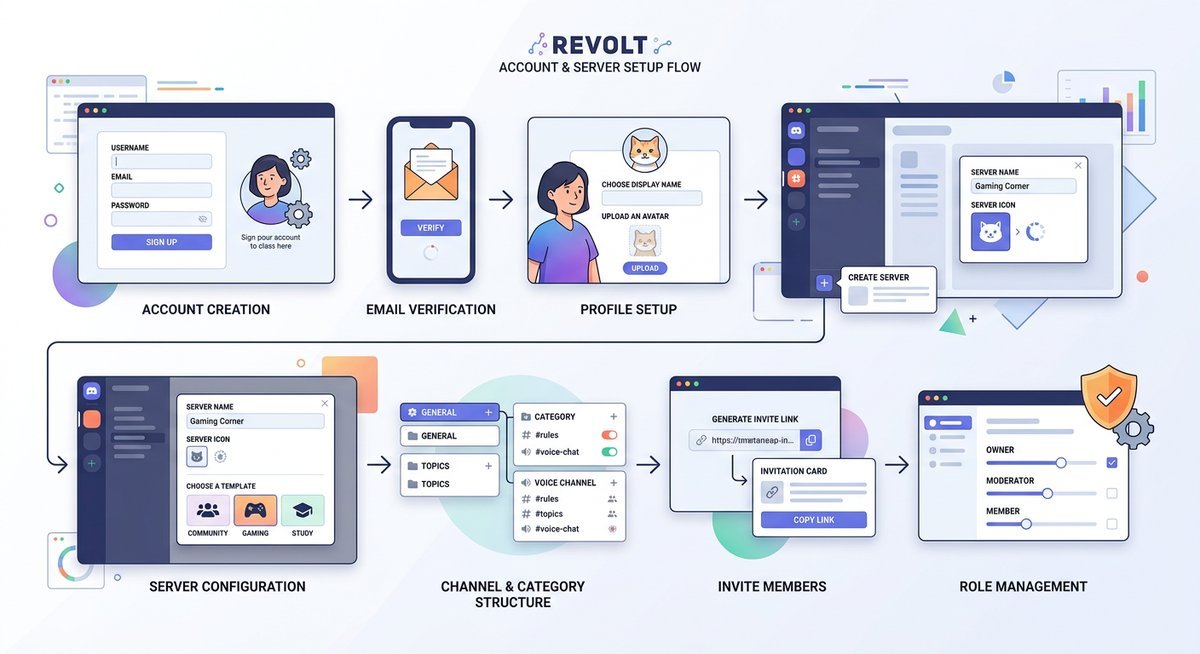
Create an Account and Set Up Your First Server
Registration requires only an email address and password. No phone number. No date of birth. A verification email arrives within seconds; clicking the link activates the account immediately.
Setting up a community server on this open-source messaging platform:
- Click the + icon in the left sidebar and select Create a Server.
- Enter a server name and upload an optional icon.
- Add text channels (e.g., #general, #announcements) and voice channels as needed.
- Configure roles and permissions under Server Settings to control who can moderate, post, or manage channels.
- Copy the invite link from Server Settings → Invites and share it with your community.
The permissions system mirrors Discord’s role hierarchy closely. Community owners migrating from Discord will find the structure immediately familiar, and the same server architecture works identically on self-hosted instances.
Who Is Revolt Chat Best For?
Revolt Chat serves three distinct audiences better than any single competitor: privacy-focused communities, open-source enthusiasts who want to self-host, and budget-conscious server owners who refuse to pay for features that should be free.
Privacy-Focused Communities and Teams
Organizations handling sensitive communications — legal teams, healthcare groups, activist networks, or any team subject to GDPR or similar data protection regulations — get a messaging platform where self-hosting eliminates all third-party data exposure. No other Discord-like platform offers this level of data sovereignty without enterprise pricing.
Developers and Self-Hosters
The Rust-powered backend, Docker deployment support, and Kubernetes compatibility make Revolt Chat a serious option for infrastructure teams. The Revolt Chat self-hosted Docker guide walks through the full six-container stack — API, WebSocket, file proxy, MongoDB, Redis, and MinIO — with annotated configuration and reverse proxy setup.
Budget-Conscious Community Owners
Gaming communities, hobbyist groups, and educational organizations that need Discord-level functionality without Discord-level costs find Revolt Chat compelling. Every feature — voice channels, file uploads, custom roles, unlimited servers — is free with no Nitro-style paywalls restricting access.
Frequently Asked Questions
What is Revolt Chat and how does it work?
Revolt Chat is a free, open-source messaging platform with servers, text channels, voice chat, roles, and permissions — structured nearly identically to Discord but with no ads, no subscription fees, and a publicly auditable codebase. The platform now officially operates as Stoat.chat, though Revolt Chat remains the widely recognized name. Created by Paul Makles in 2021, it has grown to over 600,000 registered users.
Is Revolt Chat safe and private to use?
Revolt Chat’s hosted service collects only an email address, username, and message content — no behavioral advertising profiles are built from this data. Self-hosting eliminates third-party data exposure entirely. The codebase is open-source under the AGPL-3.0 license, meaning security researchers can audit every line of code for vulnerabilities or hidden data collection.
Is Revolt Chat free to use?
Revolt Chat is completely free with no premium subscription tiers. Every feature — text channels, voice chat, file uploads (up to 20 MB), custom roles, server creation — is available to all users at no cost. The project sustains itself through donations and community contributions rather than subscription revenue.
Is Revolt Chat open source?
Yes. Revolt Chat’s entire stack — backend, frontend, API, and mobile apps — is open-source under the AGPL-3.0 license. All repositories are publicly hosted on GitHub (originally at github.com/revoltchat, now migrated to github.com/stoatchat). Anyone can inspect, fork, or contribute to the codebase.
Is Revolt Chat a good alternative to Discord?
Revolt Chat is a strong Discord alternative for communities prioritizing zero cost, privacy, and data ownership. The bot ecosystem, mobile app polish, and screen sharing features still lag behind Discord. Communities heavily dependent on third-party bots or mobile-first workflows will feel those gaps most acutely.
Can you self-host Revolt Chat on your own server?
Yes. The complete Revolt Chat stack is deployable via Docker or Kubernetes on any server. Self-hosted instances give administrators full control over data storage, user access, and configuration with zero dependency on Revolt’s central infrastructure. The official self-hosting guide is maintained at github.com/stoatchat/self-hosted.
How many users does Revolt Chat have?
Revolt Chat (now Stoat.chat) has over 600,000 registered users as of early 2025, according to the official Stoat.chat about page. The platform crossed 100,000 users in June 2023 and 500,000 users in October 2024, showing consistent growth in the open-source messaging space.
What is the file upload limit on Revolt Chat?
Revolt Chat allows file attachments up to 20 MB per upload for all users — no paid tier required. Avatar uploads are capped at 4 MB, profile backgrounds at 6 MB, and custom emoji at 500 KB. Self-hosted instance administrators can adjust these limits in the server configuration.
Who owns Revolt Chat?
Revolt Chat was created by Paul Makles (GitHub username insertish) and operates under the corporate entity Revolt Platforms Ltd. Makles remains the lead developer and maintainer. The project is community-funded through donations rather than venture capital or advertising revenue.
Does Revolt Chat have an iOS app?
Revolt Chat’s iOS app is currently available as a beta through Apple TestFlight, requiring iOS 18.0 or later. The app has not yet reached stable release on the standard App Store. iPhone users who prefer a stable experience can access Revolt Chat through the mobile web client at app.revolt.chat using Safari.
Wrapping Up
Revolt Chat — now evolving under the Stoat.chat brand — is the most feature-complete open-source Discord alternative available. Over 600,000 users, a Rust-powered backend, AGPL-3.0 licensing, and genuine self-hosting capability make it a serious platform, not a hobby project.
Gaming communities escape Nitro-style paywalls. Developer teams keep proprietary conversations off third-party infrastructure. Privacy-conscious organizations get community server software they can actually audit and trust. Few platforms serve all three groups without asking anyone to pay or compromise.
Visit stoat.chat (formerly revolt.chat) to create a free account, or explore the self-hosting route through the official GitHub repositories at github.com/stoatchat.
Last modified: March 26, 2026