7+ Best Rapid Index Checker Alternatives (Free & Paid Options for 2026)
So, you spent hours creating the perfect piece of content, only for it to disappear into the void. If Google doesn’t see it, does it even exist? This is the gap many SEOs and site owners fall into—the frustrating space between hitting “publish” and actually showing up in search results. The first step out of this limbo is simple: verification. You need a Google index checker to confirm your URL is actually in Google’s library.
Many people have heard of Rapid Index Checker, but the market has a lot more to offer. Before we get into the rapid index checker alternatives, let’s clear one thing up. Index Checkers are tools that verify if a URL is indexed. Indexers are services that try to submit your URLs to get them indexed. This article is about the checkers—the tools that tell you where you stand.
This guide will walk you through the best free and paid alternatives to Rapid Index Checker, helping you find the right tool to make sure your work gets the visibility it deserves.
Let’s Be Honest: Google Search Console Isn’t Enough
Google Search Console (GSC) is non-negotiable. It’s your direct line to Google. But for checking index status in real-time and at scale, it has some real-world limitations that push people toward third-party tools.
For starters, the URL Inspection API caps you at 2,000 URLs per day for each website you manage. If you’re an agency with several large clients, you’ll burn through that quota before lunch. Then there’s the data lag. GSC reports can be a few days behind, meaning a page could drop out of the index and you wouldn’t know until you’ve already lost traffic. Lastly, GSC only works for sites you own. That makes it useless for checking if your backlinks got indexed or for monitoring a competitor’s content velocity.
The Best Rapid Index Checker Alternatives: At a Glance
Here’s a quick rundown of the top bulk Google index checker tools to help you compare your options.
| Tool | Best For | Pricing Model | Free Plan? | Bulk Check Limit | API Access? |
|---|---|---|---|---|---|
| IndexCheckr | Pay-As-You-Go Flexibility | Credits | Yes (50 credits) | Unlimited | Yes |
| SpeedyIndex | High-Volume & API Use | Tokens | Yes (100 tokens) | 100,000+ | Yes |
| Sitechecker | All-in-One SEO Toolkit | Subscription | Yes (Basic) | Varies | Yes |
| Screaming Frog | Technical SEO Audits | License (Annual) | Yes (500 URLs) | Unlimited | Yes |
| Sight AI | Automated Indexing & Checking | Subscription | Yes (14-day trial) | Varies | Yes |
| H-Supertools | Free Bulk Checks | Free | Yes | 20 URLs | No |
| Small SEO Tools | Quick Single Checks | Free | Yes | 1 URL | No |
Top 5 Paid Rapid Index Checker Alternatives (In-Depth Reviews)
For the pros, agencies, and businesses that need more firepower, these paid tools offer the features to monitor and manage Google index status at scale.
1. IndexCheckr (Best for Pay-As-You-Go Flexibility)
IndexCheckr’s main selling point is its credit-based system. You buy credits and use them when you need them, with no monthly subscription draining your bank account. This is a breath of fresh air for anyone whose index checking needs aren’t consistent. If you have a slow month, you don’t pay.
It has all the features you’d expect: bulk URL uploads, scheduled recurring checks with email alerts, and integrations with indexing services like Omega Indexer and IndexMeNow. It even has a Chrome extension for checking pages on the fly. Pricing starts at $15 for 2,000 credits, which makes it easy to get started without a big commitment.
2. SpeedyIndex (Best for High-Volume API & Bulk Checks)
SpeedyIndex is built for one thing: scale. It’s for the SEO agencies and developers who are dealing with massive lists of URLs and need to check them programmatically. It can handle over 100,000 URLs in one go and has a robust REST API for automation. If you’re doing large-scale audits or verifying a huge backlink campaign, this is your tool.
The platform uses a token system where you buy credit packs that never expire. It’s a predictable pricing model. The interface is a bit more technical, but that’s the trade-off for its raw power.
3. Sitechecker (Best All-in-One SEO Tool with Index Checking)
Sitechecker is a full SEO platform where Google index checking is just one piece of the puzzle. It also does site audits, rank tracking, and on-page analysis. If you need an all-in-one tool, it’s a strong contender. Its index checker offers instant verification and ongoing monitoring, and it’s good at flagging technical problems that might be hurting your indexation.
It’s probably overkill if you only need an index checker, but its subscription price is competitive for a complete SEO suite. The dashboard is clean and makes it easy to see how indexing issues connect to other problems on your site.
4. Screaming Frog SEO Spider (Best for Technical SEO Audits)
Every technical SEO knows and loves the Screaming Frog SEO Spider. This desktop crawler integrates with the GSC URL Inspection API, letting you pull indexation data directly into your crawl reports. This is huge because you can cross-reference index status with all the other data points Screaming Frog collects, like crawl depth and canonical tags.
The free version lets you crawl up to 500 URLs. The paid license gives you unlimited crawling and full API access. It’s a more hands-on tool that requires a desktop app, but nothing beats it for deep, diagnostic dives into complex indexability problems.
5. Sight AI (Best for Automated Indexing & Checking)
Sight AI is an interesting hybrid. It checks your index status, but it also tries to automate the submission process. It monitors your sitemap and uses the IndexNow protocol to ping Google and Bing whenever you publish or update content. The goal is to get your pages crawled and indexed faster.
If you’re publishing a lot of content, Sight AI offers a compelling “set it and forget it” workflow. While its main job is automation, the dashboard gives you the checking and monitoring you need to see if it’s actually working. It’s a solid choice if you want to both verify and speed up your indexing.
Top 2 Free Rapid Index Checker Alternatives
If you’re on a tight budget or just need a quick check, these free tools get the job done without costing a dime.
1. H-Supertools
The big win for H-Supertools is its free bulk checking feature. You can check up to 20 URLs at once, a feature most free tools don’t offer. This makes it genuinely useful for bloggers or small site owners who need to verify a small batch of new content without any cost.
2. Small SEO Tools & SEO Tools Centre
These tools are your basic, no-frills single-URL checkers. Their strength is their simplicity. You land on the page, paste a URL, and get an answer. They’re perfect for that one-off check when you don’t want to log into a big platform.
Which Index Checker Tool Is Right for You? A Practical Guide
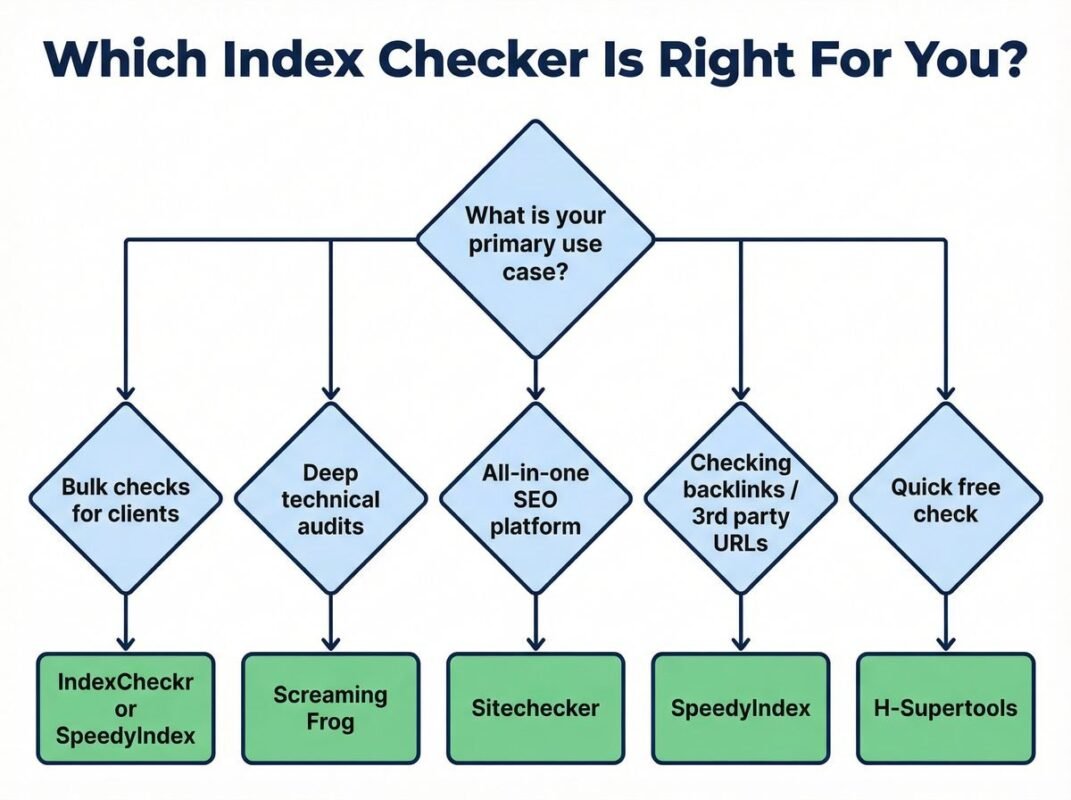
The “best” tool is the one that fits your workflow. Here’s a quick guide to help you choose the right Rapid Index Checker alternative for your needs.
For SEO Agencies: You need bulk processing and client reporting. IndexCheckr and SpeedyIndex are your best bets.
For In-House SEOs: You’ll likely want a mix of GSC for the raw data and a tool like Sitechecker or Screaming Frog for deeper analysis.
For Link Builders: Your main job is checking URLs on sites you don’t own. SpeedyIndex and IndexCheckr are made for this.
For Bloggers & Small Business Owners: Start free. H-Supertools is great for small batches, and IndexCheckr’s pay-as-you-go plan is perfect if you only need it occasionally.
For Developers: If you’re building index checking into your own tools, you need an API. SpeedyIndex is the clear choice here.
Frequently Asked Questions (FAQ)
What is the best free Google index checker tool?
For checking a bunch of URLs at once, H-Supertools is the winner because it lets you check 20 for free. For a single URL, Small SEO Tools is quick and easy.
How do I check if multiple URLs are indexed by Google at once?
Paid tools like IndexCheckr and SpeedyIndex are built for this, handling thousands of URLs. For smaller batches, H-Supertools is a great free option.
What’s the difference between an index checker and an indexer tool?
An index checker tells you if a URL is already in Google. An indexer tool tries to get a URL into Google. Two different jobs, and it’s worth knowing which one you actually need.
How accurate are third-party index checkers?
The good ones are very accurate. They use either live SERP checks or the official GSC API to see what’s really happening in the search results right now.
Why not just use the “site:” operator in Google?
Because it’s not reliable. The “site:” command can show you outdated or incomplete information. It’s fine for a casual glance, but not for serious SEO work.
Can I check the index status of backlinks on websites I don’t own?
Yes. This is exactly why people use third-party tools. GSC won’t let you, but SpeedyIndex and IndexCheckr will.
How long does it take for a page to get indexed?
Anywhere from a few hours to a few weeks. It depends on your site’s authority, crawl budget, and how well you’ve set up your internal linking and sitemaps. These tools help you keep an eye on it.
Conclusion
Making sure your content gets indexed is the first hurdle in SEO. GSC is your starting block, but its limitations mean you’ll eventually need a more specialized tool. Whether it’s the flexible pricing of IndexCheckr or the raw API power of SpeedyIndex, there’s a Rapid Index Checker alternative that fits your needs and budget.
By picking the right tool, you can stop guessing and start knowing where your content stands. You can finally get the confidence that your hard work is actually visible to the one audience that matters: Google.
Last modified: March 6, 2026