Is Kiwi.com Legit? What Travelers Need to Know Before Booking

Millions of travelers land on Kiwi.com every month, spot a fare that’s $80 cheaper than anything on Google Flights, and immediately ask the same question: is this a scam?
The short answer: Kiwi.com is a real, registered online travel agency headquartered in Brno, Czech Republic. It has processed hundreds of millions of bookings since launching in 2012. Tickets purchased through the platform are genuine airline tickets. It is not a fraud operation.
But cheap and legitimate are not the same as risk-free. Kiwi.com operates on a fundamentally different model than Expedia, Google Flights, or booking with an airline directly. It’s called virtual interlining — and it’s the source of both those suspiciously low fares and the genuine risks that blindside unprepared travelers.
Know the difference before you enter your credit card number. That’s the gap between a great deal and a 2 a.m. airport nightmare.
What Is Kiwi.com and How Does It Actually Work?
Kiwi.com is a Czech online travel agency that finds cheaper flight routes by combining tickets from unrelated airlines into a single itinerary — a technique called virtual interlining. The platform is legitimate and the tickets are real, but the booking mechanics create risks that don’t exist on traditional travel platforms.
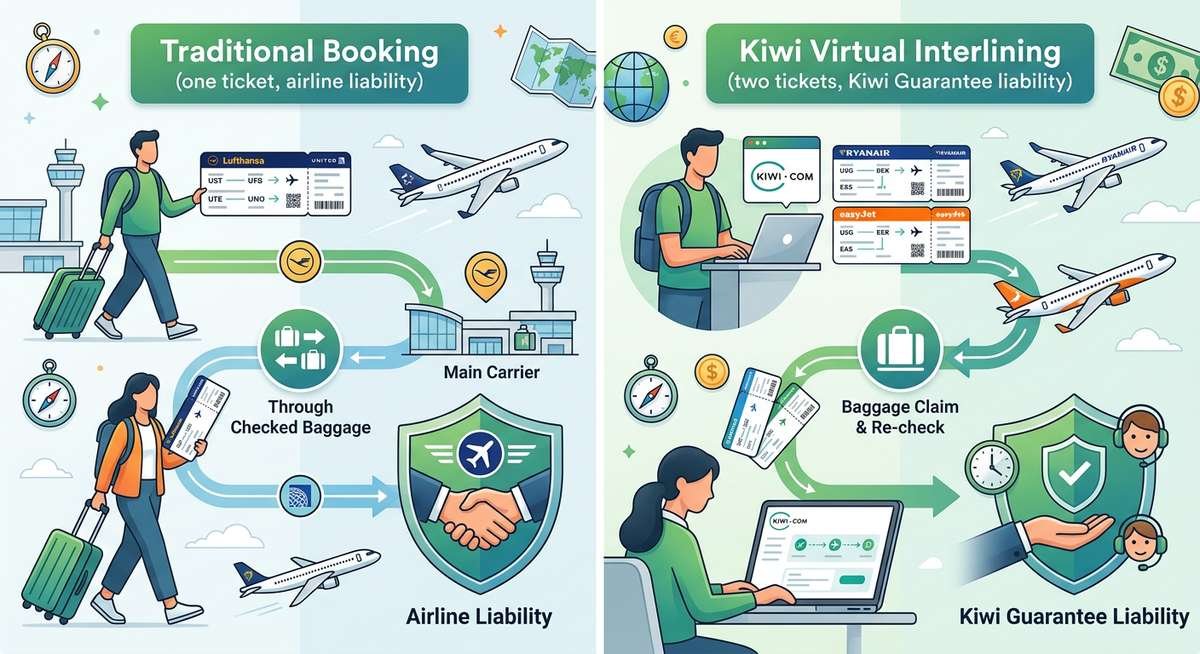
Virtual Interlining Explained Simply
Kiwi’s algorithm scans flights across dozens of carriers and stitches together an itinerary that no single airline sells. A London-to-Bangkok route might combine a Ryanair leg to Warsaw with a LOT Polish Airlines connection to Tokyo, then a budget carrier onward to Bangkok. Each leg is a separate ticket.
No single airline knows about, or bears responsibility for, the other tickets. If your Ryanair flight lands 90 minutes late and you miss the LOT departure, Ryanair’s obligation ends in Warsaw. LOT has no record of your onward journey. You are holding unrelated tickets, and the airline rebooking desk will treat you exactly that way.
The protection that bridges those gaps — or attempts to — is Kiwi’s own proprietary guarantee. Not IATA interline agreements. Not airline policy. Not EU passenger rights regulations (those still apply to each individual ticket, but not across them).
How Kiwi Differs From Other Booking Platforms
When you book a connecting itinerary through an airline or a traditional OTA like Expedia, the flights typically operate under IATA interline agreements. A delay on Leg 1 triggers an automatic rebooking obligation on Leg 2 — at the airline’s cost.
Google Flights doesn’t book anything at all; it redirects you to airlines or OTAs where those IATA protections apply. Skyscanner works similarly. Kiwi replaces that entire safety net with its own guarantee system, which has eligibility rules, exclusions, and response-time realities that differ dramatically from what you’d get under standard airline obligations.
| Booking Method | Ticket Type | Missed Connection Liability | Baggage Transfer | Cost to Traveler if Disrupted |
|---|---|---|---|---|
| Airline direct / traditional OTA | Single itinerary (one PNR) | Airline (IATA interline) | Automatic through-check | None — airline rebooks free |
| Kiwi.com virtual interline | Separate tickets per carrier | Kiwi.com (proprietary guarantee) | Must collect and re-check at each stop | Covered only if guarantee conditions met |
| DIY self-transfer (manual booking) | Separate tickets | Traveler bears full risk | Must collect and re-check | Full out-of-pocket |
Baggage is where this difference bites hardest. On a traditional connection, checked bags transfer automatically. On a Kiwi virtual interline, you collect luggage at each transfer point, clear security again, and re-check with the next carrier. Budget 90 minutes minimum — more at larger airports or peak hours.
What a Disruption Actually Looks Like
You booked London to Bangkok through Kiwi: Ryanair to Warsaw, then LOT to Bangkok with a three-hour layover. Ryanair delays two hours. You land in Warsaw with 50 minutes until the LOT gate closes.
Ryanair’s response: “Your ticket was London to Warsaw. You arrived in Warsaw. We’re done.” LOT’s response: “We have no record of an onward booking in your name.” You’re standing in a foreign airport at 11 p.m. with two separate booking references and one option — contact Kiwi’s support chat and wait.
If your itinerary qualifies under the Kiwi Guarantee, support rebooks you on the next available flight. If it doesn’t qualify — maybe the layover was below the minimum buffer — you’re buying a new ticket at the airport counter price. That’s the real stakes of virtual interlining, and it’s the scenario every potential Kiwi user should visualize before clicking “pay.”
The Kiwi Guarantee — What It Covers and What It Doesn’t
The Kiwi Guarantee is Kiwi.com’s proprietary protection layer that replaces the interline rebooking rights you’d normally get from an airline. If a delay on one Kiwi-assembled segment causes you to miss the next, Kiwi commits to rebooking you or refunding the affected leg. Whether that holds in practice depends on which guarantee tier you have and what caused the disruption.
Standard Kiwi Guarantee
Included automatically on eligible virtual interlining itineraries at no extra charge. If a Kiwi-booked flight runs late and you miss your connecting segment, Kiwi’s customer team rebooks you on the next available flight or issues a refund for the unused portion.
Scope is the critical boundary. Only the connections Kiwi itself assembled are covered. Flights you manually added or booked outside the platform? Excluded. Layover time below Kiwi’s minimum connection buffer? Also excluded.
Kiwi Guarantee Plus (Paid Add-On)
Available at checkout for roughly €5 to €15 per passenger depending on route complexity. The upgrade expands protection in three meaningful ways: broader cancellation coverage including some airline-initiated schedule changes, faster rebooking prioritization during disruptions, and higher compensation caps.
Worth serious consideration on tight-layover itineraries, expensive multi-leg bookings, or routes through regions with chronically unreliable carriers. A two-hour connection in Frankfurt is manageable. A 55-minute transfer at a secondary airport served by one budget carrier is a different calculation entirely.
| Feature | Standard Guarantee | Guarantee Plus |
|---|---|---|
| Missed connection rebooking | Yes | Yes (priority handling) |
| Refund on missed segment | Yes (capped) | Yes (higher cap) |
| Airline-initiated cancellations | Limited | Broader coverage |
| Traveler-caused delays | Not covered | Not covered |
| Visa/passport issues | Not covered | Not covered |
| Add-on cost | Included free | ~€5–€15 per person |
Key Exclusions to Know Before You Book
Neither guarantee tier covers delays caused by the traveler — late arrivals to the gate, failed security checks, or forgetting travel documents. Visa and passport problems are excluded entirely. And if your disruption qualifies for compensation under EU Regulation 261/2004 (flights departing from or arriving in the EU on EU carriers), that claim goes directly to the airline, not Kiwi.
Perhaps the most important exclusion: if the layover time on your Kiwi itinerary dips below the platform’s own minimum connection threshold — which varies by airport — the guarantee may not apply at all. Always check the guarantee eligibility indicator on the booking page before paying.
Kiwi.com vs. Skyscanner, Google Flights, and Booking Direct
Price comparisons across platforms tell a clear story: Kiwi regularly surfaces fares 15–40% cheaper than Google Flights or Skyscanner for the same route. Those savings are real. But the trade-offs are real too, and the right platform depends on the kind of trip you’re taking and how much risk you’re willing to absorb.
| Platform | Strength | Weakness | Best For |
|---|---|---|---|
| Kiwi.com | Cheapest complex routes, creative combinations | Separate tickets, support delays, guarantee limits | Flexible budget travelers, carry-on only trips |
| Google Flights | Fast comparison, price tracking, transparent | No booking — redirects to airlines/OTAs | Initial research and price benchmarking |
| Skyscanner | Wide OTA coverage, price alerts | Redirects to third-party bookers of varying quality | Finding the cheapest traditional booking option |
| Airline direct | Full protection, loyalty points, direct support | Higher prices on multi-carrier routes | Business travel, checked bags, tight connections |
Try searching the same multi-stop route on Google Flights and Kiwi.com side by side. Under $30 difference? Book direct for the protection. Over $80 cheaper on Kiwi? That gap means virtual interlining is generating a genuinely different route — and that’s where the value proposition lives. Also consider pairing a Kiwi booking with a standalone travel insurance policy that covers missed connections; the combination often costs less than booking direct while adding a safety net Kiwi’s guarantee alone doesn’t fully provide.
Is Kiwi.com Trustworthy? What Real Users Say
On Trustpilot, Kiwi.com holds a 4.1 out of 5 across more than 70,000 reviews as of early 2025. That’s a genuinely solid score for an OTA operating at this scale. The sentiment split, though, tells a more nuanced story than any single number.
Where Kiwi.com Earns Praise
The most consistent positive: price. Travelers regularly report savings of 20–40% on routes involving regional carriers or multi-stop combinations no single airline sells as one ticket. The Kiwi mobile app draws frequent compliments for clean design and real-time flight tracking. Budget backpackers and flexible travelers — people who prioritize cost over convenience and travel carry-on only — tend to be the platform’s most satisfied users.
The Most Common Complaints
Customer support failures dominate the negative reviews, particularly during disruptions. Travelers describe waiting hours for chat responses at the exact moment they needed urgent rebooking. Refund timelines are another recurring pain point — multiple verified reviewers on Reviews.io report waits exceeding 90 days for approved refunds to actually arrive.
A subtler but important pattern: many users didn’t understand what the Kiwi Guarantee covered until a crisis made the gaps painfully clear. The disconnect between marketing language (“we’ve got you covered”) and actual policy terms is a legitimate criticism.
| Review Theme | Sentiment | Frequency |
|---|---|---|
| Price savings on complex routes | Positive | Very High |
| App usability and interface | Positive | High |
| Customer support response speed | Negative | Very High |
| Refund processing delays | Negative | High |
| Guarantee confusion during disruptions | Negative | Moderate |
Putting the Review Numbers in Context
Any OTA processing millions of bookings annually will accumulate thousands of negative reviews. That’s arithmetic, not automatically a red flag. The meaningful question is whether complaints cluster around a structural problem — systematic fraud, fake tickets, phantom charges — or a process problem like slow support queues.
For Kiwi.com, the evidence points clearly toward the latter. Tickets are genuine. Airlines confirm the bookings. The real problem is execution under pressure — getting help when things go wrong and getting refunds processed in a reasonable timeframe.
The COVID-Era Refund Crisis — and What Changed
Much of Kiwi.com’s negative reputation traces back to the 2020–2022 period, when pandemic-related cancellations overwhelmed the platform’s refund system. Thousands of travelers reported months-long waits for refunds on flights that airlines had already cancelled. Czech consumer protection authorities received a spike in complaints, and the company’s Trustpilot score dropped significantly during this period.
Kiwi has since restructured its customer support operations and refund processing pipeline. Post-2023 reviews show measurably faster resolution times, though delays still surface during high-disruption events. The COVID episode is important context: it explains why so many “is Kiwi a scam?” searches exist, even though the underlying ticket-delivery system was never the problem.
Is Kiwi.com Regulated?
Kiwi.com s.r.o. is a registered company in the Czech Republic (company ID 29352886) and operates as a licensed travel agency under Czech trade law. It is not IATA-accredited — the company books through a mix of airline APIs and GDS connections rather than through the traditional IATA-accredited agent framework. This is common for online-only OTAs but means Kiwi does not carry IATA’s financial bonding protections. Travelers booking from the UK should note that Kiwi does not hold ATOL protection either, which only applies to UK-based package holiday operators.
Who Should Use Kiwi.com — and Who Shouldn’t
Not every traveler should use Kiwi, and not every trip suits the platform. The savings are real — but so are the trade-offs, and they hit certain trip types much harder than others.
Good Fit
- Budget backpackers traveling carry-on only — no checked bags means no baggage transfer complications at self-transfer points
- Flexible itineraries with generous layovers — if you can build in 4+ hours at transfer airports, the missed-connection risk drops substantially
- Solo travelers comfortable navigating airports independently — self-transfers require confidence with re-checking in at a new terminal or airline
- Routes with no good direct options — obscure city pairs where Kiwi’s algorithm genuinely surfaces routes no one else offers
Poor Fit
- Families with young children and checked luggage — collecting bags, clearing security, and re-checking at transfer points with kids is stressful and time-consuming
- Business travelers on tight schedules — a missed virtual interline connection could cost an entire meeting day with no guaranteed rebooking timeline
- Anyone booking a trip with non-refundable commitments at the destination — a prepaid hotel, cruise departure, or event ticket amplifies the financial risk of a disrupted Kiwi itinerary
- Travelers who want a single point of accountability — if calling one airline and having them sort everything out is important to you, book direct
Frequently Asked Questions
Is Kiwi.com a scam?
No. Kiwi.com is a licensed Czech travel agency operating since 2012. Tickets are real airline tickets with valid booking references. The “scam” label typically comes from travelers who didn’t understand virtual interlining and were caught off guard when separate tickets behaved differently from a single-itinerary booking.
What happens if I miss a connection booked through Kiwi.com?
If the delay was on a Kiwi-booked segment and your itinerary qualifies under the Kiwi Guarantee, Kiwi rebooks you on the next available flight or refunds the unused leg. If the miss was your fault or the layover fell below the minimum buffer, you’re responsible for rebooking at your own cost.
Does Kiwi.com transfer my checked bags between flights?
No. Each virtual interlining segment is a separate ticket with a separate airline. You must collect checked luggage at every transfer point, clear security again, and re-check with the next carrier. Travel carry-on only when possible to avoid this hassle.
How long do Kiwi.com refunds take?
Kiwi’s stated timeline is 10 business days after approval. Real-world reports on Trustpilot and Reviews.io show 30 to 90+ days is common. If overdue, escalate through the app, file a complaint with Czech consumer protection, or initiate a credit card chargeback.
Is Kiwi.com cheaper than Google Flights?
Often yes for complex multi-stop routes — Kiwi’s virtual interlining produces fares 15–40% below Google Flights by combining budget carriers. For simple point-to-point flights on major airlines, the price difference is usually minimal and not worth the reduced protection.
So, Is Kiwi.com Legit?
Yes. Tickets are real. The company is registered in the Czech Republic and has operated for over a decade. Fraud is not the issue.
Risk management is. Flexible solo travelers flying carry-on with generous layover buffers will find genuinely excellent fares on routes other platforms can’t touch. Families with checked bags, business travelers on tight schedules, or anyone with non-refundable commitments at the destination should book direct.
Three things to do before paying on Kiwi: read the guarantee terms for your specific itinerary, check the same route on Google Flights to know your actual savings, and consider adding standalone travel insurance if the trip matters more than the discount.
Last modified: March 19, 2026