Chief Technical Examiner: Role, Organisation, CVC Wing, and State Offices Explained

India’s Central Vigilance Commission employs two Chief Technical Examiners — senior officers at the rank of Chief Engineer — to independently inspect government construction projects and procurement contracts worth thousands of crores. The Chief Technical Examiner’s Organisation (CTEO), operational since 1957, functions as the technical wing of the Central Vigilance Commission (CVC) and holds statutory backing under the Central Vigilance Commission Act, 2003.
That statutory independence matters. A Chief Technical Examiner answers to the Central Vigilance Commission alone — not to the ministry, department, or public sector undertaking whose works are under scrutiny. Inflated estimates, excess payments to contractors, substandard materials, and bid-rigging schemes all fall within the CTE’s inspection mandate. Several Indian states — Kerala, Chhattisgarh, and Madhya Pradesh among them — have established their own state-level Chief Technical Examiner offices modelled on the central CTEO framework.
What Is a Chief Technical Examiner?
A Chief Technical Examiner is a senior technical officer within the Central Vigilance Commission who conducts independent inspections of government construction works and procurement contracts to detect financial irregularities, quality failures, and procedural violations. The role is distinct from a general auditor — a CTE physically visits project sites, re-measures completed works, and cross-checks contractor bills against actual execution.
Chief Examiner Meaning and Statutory Basis
The term chief examiner broadly refers to the senior-most examining authority within any inspection framework. In India’s vigilance architecture, the Chief Technical Examiner specifically refers to the head of the CTEO — the technical arm of the CVC. The statutory foundation comes from the Central Vigilance Commission Act, 2003, which empowers the CVC to exercise superintendence over vigilance administration in central government bodies, including technical examination of public works contracts.
The chief technical examiner is associated with the Central Vigilance Commission — not with any executing department. That institutional separation is deliberate. An officer who reports to the same ministry whose projects are being examined cannot be expected to flag irregularities without career consequences. The CTE’s reporting line runs directly to the Central Vigilance Commissioner, bypassing departmental hierarchies entirely.
The Chief Technical Examiners’ Wing
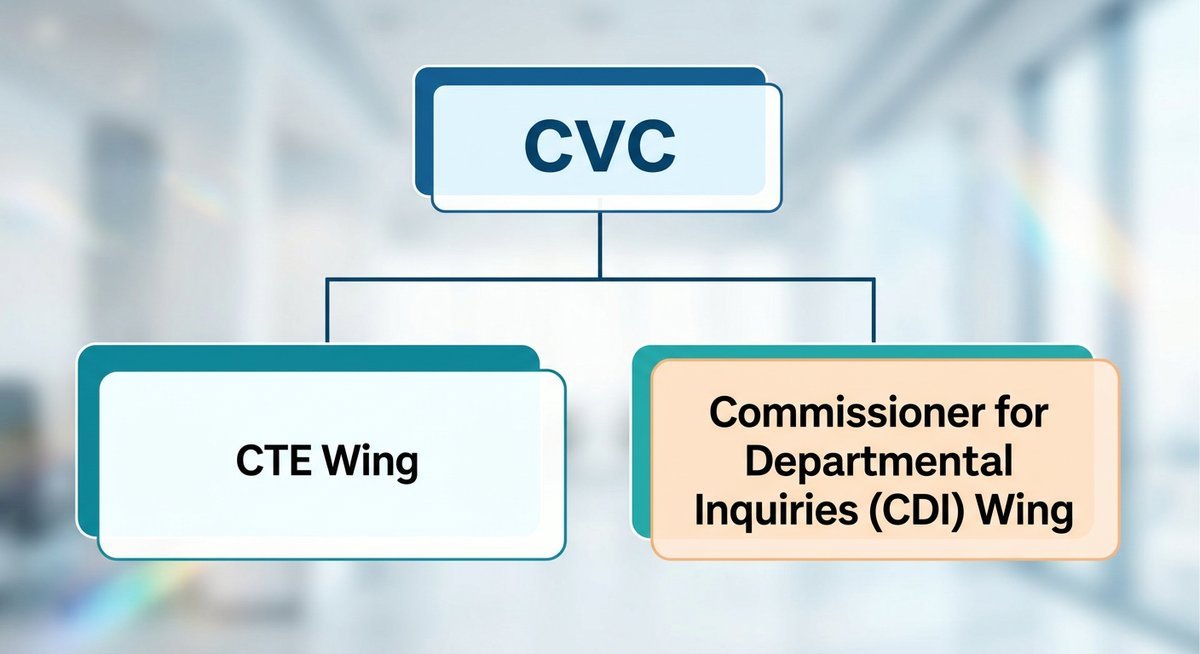
The Chief Technical Examiners’ Wing is the dedicated organisational unit within the CVC that houses the CTEs and their supporting staff. According to the CVC’s published organisational structure, the wing comprises two Chief Technical Examiners at the rank of Chief Engineer, assisted by eight Technical Examiners at the rank of Superintending Engineer. One CTE typically handles civil and horticulture-related procurement, while the other covers remaining categories.
The chief technical examiner wing operates parallel to — but separately from — the Commissioner for Departmental Inquiries (CDI) Wing. Where the CTE detects irregularities through technical inspection, the CDI conducts formal disciplinary proceedings against officials implicated in those findings. The two wings together form the CVC’s enforcement backbone.
History and Structure of the Chief Technical Examiner’s Organisation (CTEO)
The Chief Technical Examiner’s Organisation was set up in 1957 under the erstwhile Ministry of Works, Housing and Supply — seven years before the Central Vigilance Commission itself was established in 1964. That chronology reveals something important: the need for independent technical oversight of government construction predated India’s formal anti-corruption institutional framework.
When Was the CTEO Established?
The chief technical examiner’s organisation was setup in the year 1957 with a modest structure: one Chief Technical Examiner and two Technical Examiners. When the Central Vigilance Commission was created by government resolution in 1964, the CTEO was transferred under the CVC umbrella, giving it the institutional independence needed to function as a genuine external check on government departments.
A second Chief Technical Examiner post was created in 1979 to handle the expanding volume of government construction and procurement requiring oversight. Additional Technical Examiner posts were added incrementally as India’s infrastructure spending grew. The CVC Act, 2003 later codified the Commission’s statutory status, placing the CTEO’s authority on a formal legislative footing rather than executive resolution alone.
| Year | Milestone |
|---|---|
| 1957 | CTEO established under Ministry of Works, Housing and Supply with 1 CTE and 2 Technical Examiners |
| 1964 | Central Vigilance Commission created; CTEO transferred under CVC |
| 1979 | Second Chief Technical Examiner post created |
| 2003 | CVC Act enacted, giving statutory backing to the Commission and its technical wing |
Organisational Hierarchy and Staffing
How many Chief Technical Examiners are there in the organisational setup? The current structure maintains two CTEs at the apex, each at Chief Engineer rank. Below them sit eight Technical Examiners at Superintending Engineer rank, supported by additional engineering and administrative staff. CTE positions are typically filled on deputation from central engineering services — officers bring domain expertise from railways, CPWD, defence estates, or other technical cadres.

The chief technical examiner organisation deliberately draws officers from multiple engineering disciplines. Civil engineers inspect construction works. Electrical engineers examine installation contracts. Mechanical engineers scrutinise procurement of equipment and machinery. That multi-disciplinary composition ensures the CTEO can credibly assess the full range of government technical procurement.
CTE and the Central Vigilance Commission (CVC)
The chief technical examiner CVC relationship is one of direct subordination — the CTE Wing functions under the Central Vigilance Commission’s supervisory authority, and its inspection findings feed directly into the Commission’s enforcement decisions. No other government body can override or modify a CTE inspection report before it reaches the Central Vigilance Commissioner.
CTE Powers Under the CVC Framework
Under the CVC framework, a Chief Technical Examiner can inspect both ongoing and completed government works — a critical distinction. Completed projects cannot escape scrutiny simply because the final bill has been paid. The CTE retains authority to revisit them, re-measure quantities, and quantify any excess payments. During inspections, CTEs examine tender documents, measurement books, contractor bills, material quality, and workmanship standards against contract specifications.
The CTE’s jurisdiction spans central government ministries, attached departments, autonomous bodies receiving government funding, and public sector undertakings. Organisations such as National Projects Construction Corporation (NPCC), Hindustan Copper Limited, NMDC, and Coal India all fall within the CTE’s oversight purview. According to CVC guidelines on intensive examination of public procurement, organisations must facilitate CTE access without restriction — and obstruction can itself be treated as a vigilance matter.
CTE Vacancies and Deputation
Chief technical examiner CVC vacancy positions are filled through deputation from central engineering services. Officers from the Indian Railway Service of Engineers, Central Public Works Department, Military Engineering Service, and other Group A engineering cadres are eligible. The deputation tenure is typically three to five years, after which officers return to their parent cadre.
Vacancy announcements for CTE and Technical Examiner positions are published through the Department of Personnel and Training (DoPT) and circulated to eligible cadres. Candidates must hold the rank of Chief Engineer (for CTE posts) or Superintending Engineer (for Technical Examiner posts) in their parent service. Selection involves a review of service record, vigilance clearance, and relevant technical experience.
CTE Across Indian States
Several Indian states have established their own Chief Technical Examiner offices to perform technical oversight of state-funded construction and procurement — functions that parallel the central CTEO but operate under state government authority. Kerala, Chhattisgarh, and Madhya Pradesh each maintain active state-level CTE setups.
Chief Technical Examiner Kerala
The Government of Kerala positions its Chief Technical Examiner under the state Finance Department, with a mandate to inspect public works executed by state agencies. Chief technical examiner Kerala orders — government orders governing CTE inspection protocols — are issued periodically by the Finance Department to update reporting requirements and inspection thresholds.
A notable example is G.O.(P) No. 167/2020/Fin dated 31 December 2020, which revised the guidelines for submission of reports to the Chief Technical Examiner for Kerala state works. The chief technical examiner government of Kerala Thiruvananthapuram office reviews public works projects across departments including the Public Works Department, Water Resources, and Local Self Government. Non-governmental accredited agencies executing government-funded projects in Kerala must also submit reports through competent engineers appointed by the client organisation.
The chief technical examiner address for the Kerala office is located in the Finance Department complex in Thiruvananthapuram (Trivandrum), the state capital. Inspection orders and circulars are published on the Kerala Finance Department portal.
Chief Technical Examiner Chhattisgarh and Madhya Pradesh
Chhattisgarh established its Chief Technical Examiner (Vigilance) organisation on 21 December 2000, shortly after the state was carved out of Madhya Pradesh on 1 November 2000. The chief technical examiner Chhattisgarh office — also referenced as chief technical examiner CG — oversees inspection of works executed by the state Public Works Department, Water Resources Department, Rural Mechanical Services, and Pradhan Mantri Gram Sadak Yojana (PMGSY) projects.
Madhya Pradesh maintains its own Chief Technical Examiner office under the General Administration Department. The chief technical examiner MP setup predates the Chhattisgarh separation and continues to function independently for MP state works. Both state CTE offices issue their own circulars and inspection guidelines, operating under state government authority rather than the central CVC framework.
Chief technical examiner circulars at both central and state levels serve as the primary instrument for updating inspection protocols, reporting formats, and procurement oversight thresholds. These circulars carry administrative force and must be complied with by all executing agencies within the respective jurisdiction.
The CTE Inspection Process
A Chief Technical Examiner inspection follows a four-stage lifecycle — selection, on-site examination, reporting, and follow-up — that can span several months for large infrastructure projects. Each stage serves a distinct purpose in the accountability chain.
Selection and Desk Review
Works are selected for examination through risk-based profiling of high-value contracts, complaints from whistleblowers or Chief Vigilance Officers, specific CVC directives, or suo motu action by the CTE Wing. Before any site visit, the examining officer reviews sanctioned estimates, tender files, work orders, contractor agreements, and measurement books. This desk review identifies paper-trail discrepancies before the field inspection begins.
On-Site Examination
The field phase is forensic. The CTE physically re-measures completed or ongoing works, cross-checks measurements against contractor bills submitted for payment, and tests material quality on-site — checking concrete mix ratios, road layer thickness, or structural steel specifications against contract requirements. Site engineers and project supervisors may be interviewed directly. For phased projects, multiple site visits are common.
Report, Follow-Up, and Action Taken
After field work, the CTE prepares an inspection report that quantifies every identified irregularity — excess payments in rupee terms, specification deviations, tendering procedure violations. The report is communicated to the Chief Vigilance Officer of the concerned organisation, who must submit an Action Taken Report (ATR) to the CVC.
| Finding Type | Typical Outcome |
|---|---|
| Excess payment to contractor | Recovery of overpaid amount from contractor or responsible officer |
| Substandard materials or workmanship | Rectification order; contractor liability for remedial cost |
| Procedural violations in tendering | Disciplinary proceedings against responsible officials |
| Cartel formation or bid rigging | Blacklisting of contractor; referral to enforcement agencies |
| Systemic procurement lapses | Policy or guideline reforms issued by CVC to all organisations |
The CVC treats unresolved ATRs as a compliance failure in their own right. Organisations that delay or provide inadequate responses face escalating scrutiny from the Commission.
Related Roles: How the Chief Technical Examiner Compares
The title “chief examiner” appears across multiple government functions, from patent offices to education boards to vigilance bodies. Each role carries a different mandate despite the shared nomenclature. The chief officer for technical services, the chief technician, and the chief technical officer all occupy distinct positions in India’s governance landscape.
| Role | Organisation/Context | Primary Function | Key Distinction from CTE |
|---|---|---|---|
| Chief Technical Examiner | CVC / State Vigilance | Independent inspection of government works and procurement | Technical audit and anti-corruption oversight |
| Chief Examiner | Education boards, examination bodies | Oversees conduct of examinations, paper-setting, evaluation | Academic assessment, not technical inspection |
| Examiner in Chief | Patent offices, military legal | Senior examining authority in specialised domains | Domain-specific review, not vigilance function |
| Chief Patent Examiner | Controller General of Patents, Designs and Trade Marks | Examines patent applications for novelty and inventive step | Intellectual property examination, not works inspection |
| Chief Technical Officer (CTO) | Corporate / government IT divisions | Technology strategy and IT infrastructure leadership | Technology management, not procurement audit |
| Chief Officer/Technical Services | Municipal corporations, utilities | Heads technical departments within local government | Service delivery management, not independent oversight |
| Chief Technician | Defence, healthcare, industry | Senior hands-on technical specialist in a specific domain | Operational technical work, not inspection authority |
The chief technician job description typically involves supervising technical staff, maintaining equipment, and ensuring operational standards in a specific facility — a hands-on operational role with no inspection or vigilance mandate. Similarly, a chief technical officer job description centres on technology strategy, systems architecture, and digital transformation — a corporate leadership position unrelated to government procurement oversight. Chief technical officer MPs (Members of Parliament) occasionally reference CTOs in parliamentary questions about digital governance, but the role bears no structural connection to the CTE function.
Notable Officers and CTE Circulars
CTE posts attract senior engineering officers from prestigious central services. Ashok Kumar, an Indian Railway Stores Service (IRSS) officer who previously served as Chief Materials Manager at Western Railway, was selected on deputation to the Central Vigilance Commission as Chief Technical Examiner. As Ashok Kumar, Chief Technical Examiner at the CVC, his tenure included high-profile engagements with major PSUs. During Vigilance Awareness Week 2022, Ashok Kumar visited NMDC’s Head Office in Hyderabad and led sessions on preventive vigilance at Coal India and IREDA.
Chief technical examiner circulars are binding administrative instruments that set the rules for how inspections are conducted, what reporting formats executing agencies must follow, and what thresholds trigger mandatory CTE review. The CVC periodically issues revised guidelines — the most significant recent update being the 2022 Revised Guidelines on Intensive Examination of Public Procurement Contracts, which updated inspection criteria to reflect contemporary procurement practices including e-tendering and reverse auctions.
Frequently Asked Questions
What does chief examiner mean?
A chief examiner is the senior-most examining authority within any inspection or assessment framework. In India’s vigilance context, the Chief Technical Examiner specifically refers to the head of the CTEO — the technical arm of the Central Vigilance Commission responsible for inspecting government construction works and procurement contracts for irregularities.
What is the Chief Technical Examiner associated with?
The Chief Technical Examiner is associated with the Central Vigilance Commission (CVC). The CTE Wing functions as the CVC’s dedicated technical inspection division, operating independently of the government ministries, departments, and public sector undertakings whose works it examines.
How many Chief Technical Examiners are there in the organisational setup of CTO?
The CVC’s organisational setup includes two Chief Technical Examiners at the rank of Chief Engineer. They are supported by eight Technical Examiners at Superintending Engineer rank. One CTE typically handles civil and horticulture procurement, while the other covers remaining categories.
When was the Chief Technical Examiner’s Organisation set up?
The CTEO was established in 1957 under the erstwhile Ministry of Works, Housing and Supply. It was transferred to the Central Vigilance Commission when the CVC was created in 1964. The CVC Act, 2003 later provided formal statutory backing for the Commission and its technical wing.
What is the chief examiner salary?
A Chief Technical Examiner at the CVC draws pay at the Chief Engineer level — Pay Level 14 (Rs 1,44,200 to Rs 2,18,200) under the 7th Central Pay Commission. Technical Examiners at Superintending Engineer rank draw Pay Level 13. A chief technician salary, by contrast, varies widely depending on the industry and organisation, typically ranging from Rs 50,000 to Rs 1,50,000 monthly in government settings.
What is the Chief Technical Examiner address?
The central CTEO office is located at the Central Vigilance Commission headquarters: Satarkta Bhawan, Block-A, GPO Complex, INA, New Delhi — 110023. State-level CTE offices are located at respective state capitals: Thiruvananthapuram (Kerala), Raipur (Chhattisgarh), and Bhopal (Madhya Pradesh).
What is the difference between a Chief Technical Examiner and a Commissioner for Departmental Inquiries?
The Chief Technical Examiner detects irregularities through on-site technical inspection of government works. The Commissioner for Departmental Inquiries (CDI) conducts formal disciplinary proceedings against officials implicated by those findings. The CTE uncovers problems; the CDI adjudicates individual accountability. Both wings operate under the CVC but perform sequential, non-overlapping functions.
Conclusion
India’s public procurement system handles government contracts across thousands of projects every year. The Chief Technical Examiner’s Organisation — operational since 1957 and backed by the CVC Act, 2003 — exists to ensure those contracts are executed honestly. Two CTEs at the central level, supported by eight Technical Examiners, conduct independent inspections that no executing department can obstruct or override.
State-level CTE offices in Kerala, Chhattisgarh, and Madhya Pradesh extend that oversight to state-funded works, applying similar inspection methodologies under their respective state government frameworks. The CTE function, whether central or state, rests on a single principle: the organisation spending the money should never be the only one checking whether it was spent properly.
Contractors operating honestly face less competition from those gaming the tender process. Officials following procedure have documented evidence of compliance. Citizens receive infrastructure that meets the specifications their taxes funded. The Chief Technical Examiner, quiet and largely invisible to the public, is what makes that accountability possible.
Last modified: March 25, 2026