The Homeowner’s Guide to Identifying Common Tree Diseases and Pests
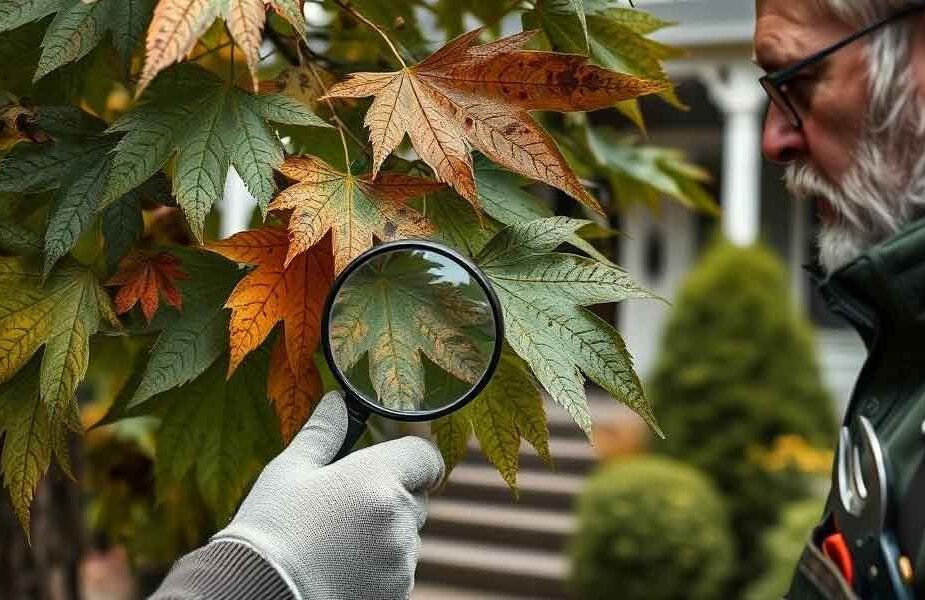
Mature trees can be an asset that appreciates over time, but that will never happen if we don’t invest in professional health care. Your trees’ value could reduce over time without the proper maintenance. Prioritize regular tree inspections by a tree specialist on your property to ensure both your mature trees and your home’s value grow and stay strong.
When You Can Treat it Yourself and When You Can’t
Topical sprays and soil drenches are the stuff for surface fungal issues, minor pest pressure, and preventative applications on young trees and highly susceptible species (like Myrtaceae family members in the face of Myrtle Rust). Spray at the first signs of infection, pour in the recommended rate, and re-administer as per the product specs.
What’s not a DIY job: significant canopy thinning over a number of sections, fungal brackets present at the base of the trunk, obvious major structural cracking, or a tree in close proximity to a building, car, or high pedestrian traffic area. For those scenarios, your tree should be assessed by an arborist. GTS Trees have a hazardous tree assessment that can provide a risk overview before any work commences.
If you have a tree in obvious decline right next to your dwelling, that’s not a gardening issue, that’s a risk to your property, for which you need professional advice, not your fingers crossed.
Seasonal Change vs. Actual Disease
That’s where most lay people get confused. If a tree drops its leaves in the autumn, it’s functioning just as nature intended. But if a tree drops its leaves in the middle of summer, or shows no hint of budding in the springtime, it’s sending a different message.
Luckily, there’s a quick-and-dirty way to tell if a branch is still alive, and it has nothing to do with scratching and staring. Take your thumb and press down on it. Vibrant and flexible tissues will have a green or cream hue. If it’s brown, dried out, and snaps, you’ve got deadwood.
Most importantly, don’t just test one or two branches. Tiny, isolated patches of deadwood might not be worth removing. If, on the other hand, the spread of deadwood is progressing incrementally from the outermost leaves inwards, you’re dealing with a more pronounced case of canopy dieback.
And in cases of dieback where the spread starts at the root and coils upwards, the problem is probably rooted in the roots, not high above the earth. One common explanation is phytophthora root rot, a condition where the tree’s root-roaming system of hydration and nutrient-gathering becomes disrupted before the results appear above ground.
What Internal Decay Actually Looks Like From the Outside
When a tree has enough internal rot to affect its stability, it’s usually been in a compromised state for many years. However, there are signs on the outside that all is not well if you know what to look for.
Weeping sap, the flow of sap around wounds or cracks in the bark, is a sure sign that the tree is stressed. And it’s not just a temporary thing in the way that weeping might be for a person. Fungi that live off the sugary sap can make the flow worse and more prolonged, indicating long-term stress, a bacterial infection, or borer activity.
Property Maintenance as a Risk Factor
Many homeowners do not realize how their tree’s health is associated with how they mow their lawn. The bark wounds caused by a mower or line trimmer can become entry points. Pathogens don’t need a large opening, a repeated nick at the base of a trunk, season after season, creates exactly the kind of chronic wound that disease and insects exploit.
Construction can have a similar effect. Trenching near root zones, soil compaction from heavy equipment, and changes to drainage patterns all stress root systems. Stressed roots are more susceptible to Phytophthora and other soil-borne pathogens.
A mulched zone around each tree is a simple solution. It protects roots from equipment damage and moderates soil temperature and reduces compaction. It’s one of the simplest protective measures around and most properties don’t do it.
Spotting Pest Activity Before it Gets Serious
Borer insects can cause some of the worst pest damage to trees. When trees become stressed by borer infestations, they become more susceptible to diseases. Unfortunately, it’s tough to see a borer coming. Until a tree is well infested, the problems are all happening out of sight.
You may see what looks like sawdust (excrement) at the tree’s base, or running along the bark. Woodpeckers are searching for borer larvae if they peck the bark frequently. Most borers will have a stage as a grub, feeding in the cambium or in the heartwood. This can cause girdling, boring tunnels through the wood, and generally weakening the tree to the point that other pests can come in and kill it.
Last modified: May 5, 2026