5 Critical Safety Steps to Take When Your Car Breaks Down on the Highway
When Your Car Stops, Your Brain Lies to You
Breaking down on the highway can make your adrenaline surge. And unrestrained adrenaline can be a dangerous thing. Surviving the highway shoulder starts with understanding how your instincts can do you wrong.
Step 1: Use Your Momentum, Not Your Brakes
If you ever experience a blowout or lose power, immediately brake gently and coast as far to the right as possible. Try to get completely onto the right shoulder, past the white line. If an exit is right there, take it. Getting completely offline costs a few hundred dollars less than a new rim. Just keep easing your way on down the road until you’re well removed from moving traffic.
Step 2: Signal Before You do Anything Else
Activating hazard lights is crucial, even before coming to a complete stop. This is an instinct you should follow.
After stopping, remain in the car with your seat belt fastened while you evaluate the situation. Don’t immediately reach for your phone, open the door, or start looking for something in the backseat. Take ten seconds to exhale and watch traffic before taking any further steps. Roughly 16% of all interstate pedestrian fatalities involve disabled or stopped motorists (National Safety Council), and most of those fatalities occur in the first few minutes as people go into autopilot.
Step 3: Exit on the Passenger Side Only
Here’s the one most people don’t know, and it’s the one that matters most. Never open the driver’s side door on a highway. At 70 mph, a vehicle is traveling roughly 100 feet per second. The right lane driver may not see you until it’s too late to react. Open the passenger door, step out on the grass or the painted shoulder, and keep moving well away from the vehicle. Get everyone in the car out the same way, no matter how awkward it may be.
Children, passengers, pets, everyone exits right and moves well away from the road. If there’s a guard rail, get behind it. If there’s an embankment, stand on it. The goal is to put a physical barrier between you and traffic. Do not sit in your car waiting for help. A secondary collision, where another vehicle hits your stopped car, is one of the leading causes of breakdown fatalities, and being inside the vehicle when that happens is not magically safer than being outside it.
Step 4: Set up Your Safety Zone
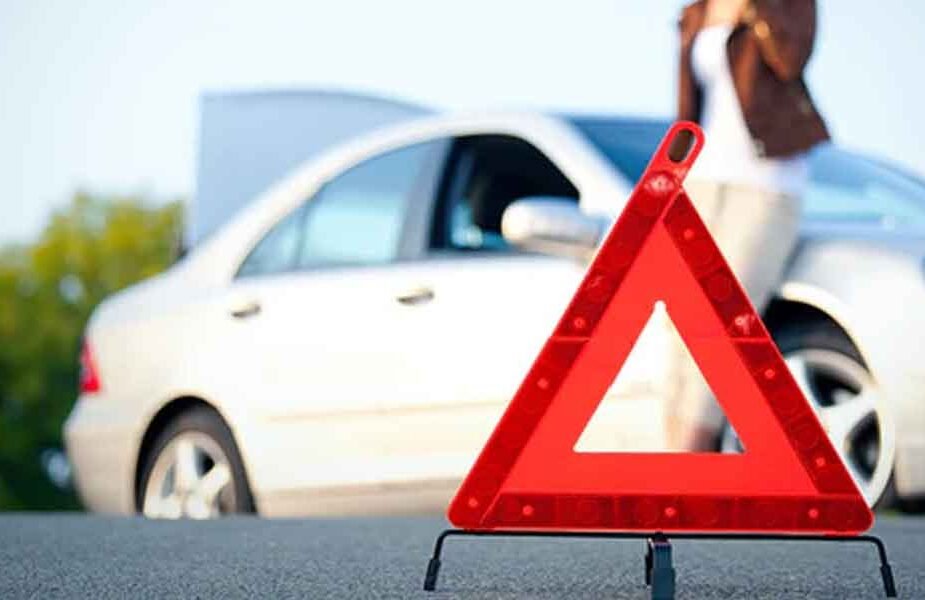
If you carry reflective triangles in the car, throw them out at three distances: 10 feet behind the vehicle, 100 feet back and 200 feet back. This way you account for the reaction time a driver needs at highway speeds to see the hazard and change lanes without overcorrecting.
If you carry a high-visibility vest, put it on before you do anything near the roadway. Visibility is the only protection you have while standing in that environment. Flares work in low-light when triangles won’t. Most drivers have neither in their car, this is worth fixing before you need it.
Step 5: Assess Honestly Before Attempting Any DIY Repair
This is how people find themselves in real trouble. Replacing a tire on firm, even ground in an empty lot is one thing. Doing it on a shoulder sloping steeply into speeding traffic is another.
Before you even handle the jack or lug wrench, assess that ground. Soft, gravelly, or severely off-camber ground can make a jack unstable. Also, if you’re considering your “donut” spare, remember it’s not designed for high speeds or long distances. It might not be safe to deploy it and limp to safety. Knowing what to do when stranded with a flat tire means realistically determining if a do-it-yourself fix is actually feasible in your circumstances, or if you should be instead calling for professional roadside help.
If in doubt, make the call. A wrecker driver is accustomed to working that situation. You aren’t.
The Mindset Matters as Much as the Steps
Break downs on the highway are low-frequency, high-consequence events. Most people will have a few in their lives, so almost no one has had a chance to practice dealing with them under stress. These steps aren’t complex, but they will all seem counterintuitive in the moment. You must think slow even when things feel fast. Get off the road, get visible, get away from the car, not the other order.
Last modified: April 8, 2026